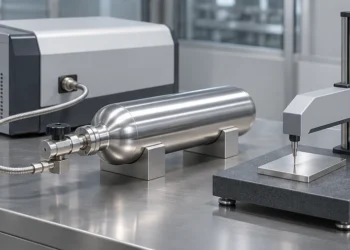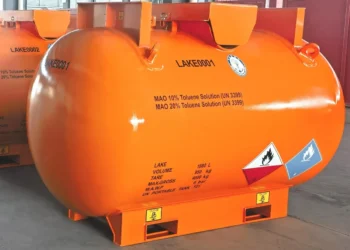
The most important difference between T50 vs. T22 tank containers is the type of hazardous material each tank is designed and approved to transport. T50 tank containers serve non-refrigerated liquefied gases and certain chemicals under pressure, while T22 tank containers are intended for specifically classified hazardous substances requiring stringent containment, shell thickness, and pressure-relief arrangements.
Although both belong to the UN portable tank system, they are not interchangeable. Their pressure requirements, valve configurations, material selection, discharge arrangements, and inspection criteria follow different engineering principles.
At KUNVESS, we approach tank container selection by examining the chemical medium before specifying the vessel. A suitable design must accommodate the physical behavior of the cargo, maintain material compatibility, protect product quality, and satisfy applicable transport requirements throughout its intended service life.
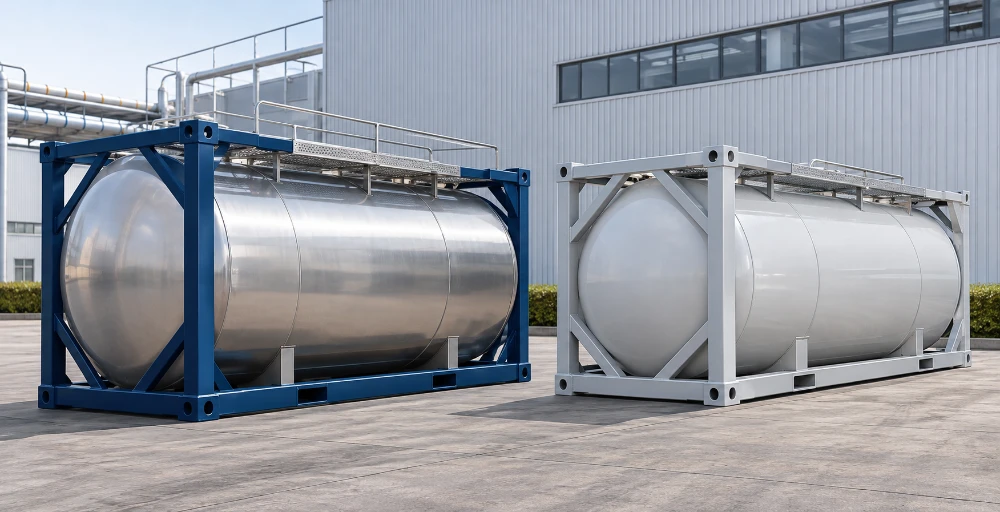
1. T50 vs. T22 Tank Containers: Technical Comparison at a Glance
T50 and T22 are portable tank instructions established under the UN Recommendations on the Transport of Dangerous Goods. These designations establish requirements for transporting particular dangerous goods rather than identifying a standardized commercial tank model with fixed dimensions, capacity, or construction materials.
Understanding this distinction prevents procurement teams from comparing equipment that serves fundamentally different purposes.
| Comparison Factor | T50 Tank Container | T22 Tank Container |
|---|---|---|
| Primary cargo category | Non-refrigerated liquefied gases and designated chemicals under pressure | Specifically assigned hazardous substances, including certain hazardous liquids |
| Applicable UN construction requirements | Section 6.7.3 | Section 6.7.2 for metallic-shell portable tanks |
| Pressure requirements | Cargo-specific MAWP requirements | Minimum test pressure of 10 bar (1.0 MPa) |
| Minimum shell thickness | Determined by applicable design requirements | 10 mm in reference steel, subject to applicable material equivalency and design requirements |
| Bottom openings | Dependent on the assigned substance | Not permitted for liquid cargo |
| Pressure-relief requirements | Cargo-specific requirements under Section 6.7.3.7 | Special requirements under Section 6.7.2.8.3 |
| Filling limitations | Cargo-specific filling ratios or applicable filling provisions | Applicable liquid filling provisions and substance-specific restrictions |
| Material selection | Based on gas compatibility, pressure, temperature, and mechanical properties | Based on chemical compatibility, corrosion resistance, mechanical properties, and approved containment design |
| Typical procurement priority | Pressure containment and gas-specific service equipment | Chemical containment integrity and corrosion management |
| Interchangeability | No automatic interchangeability between the two tank instructions | |
Regulatory reference: UN Model Regulations, 24th Revised Edition (2025), Sections 4.2.5.2.6, 6.7.2, and 6.7.3. [1]
One particularly important distinction is that the 10-bar requirement for T22 is a minimum test pressure, not a universal maximum allowable working pressure. Comparing this figure directly with the working pressure of a T50 gas tank produces a misleading assessment of mechanical capability.
Neither instruction establishes a universal tank capacity, tare weight, service temperature, stainless steel grade, or purchase price. Those characteristics belong to the individual approved design.
2. What Is a T50 Tank Container?
A T50 tank container is a specialized portable pressure vessel intended for the transportation of non-refrigerated liquefied gases and designated chemicals under pressure. Unlike conventional liquid chemical tanks, T50 equipment must accommodate cargo whose internal pressure is closely related to its thermodynamic properties and temperature.
The contents may include both liquid and vapor phases during transportation. Although much of the cargo mass can remain in liquid form, the vessel must withstand the pressure generated within the enclosed system under the applicable design conditions.
Why Liquefied Gas Requires a Different Vessel Design
A liquid chemical with relatively low vapor pressure behaves differently from a liquefied gas that depends on pressure to remain in its transported physical state.
As a non-refrigerated liquefied gas warms, its equilibrium vapor pressure can increase. The relationship between pressure and temperature varies with the substance, which explains why a single working pressure cannot represent every T50 application.
From a manufacturing perspective, pressure design influences the shell, formed heads, welded joints, nozzle reinforcement, flange connections, valves, and supporting structure. These components must function as an integrated containment system.
Increasing the pressure rating of an individual component does not necessarily increase the approved pressure capability of the complete vessel. The limitations of the assembled equipment must be evaluated together.
Typical T50 Tank Container Applications
T50 portable tank applications include permitted liquefied gases used in chemical processing, refrigeration systems, industrial gas distribution, and specialized manufacturing operations.
| Substance | UN Number | Engineering Consideration |
|---|---|---|
| Butane | UN1011 | Flammable liquefied gas containment |
| Anhydrous ammonia | UN1005 | Material compatibility, pressure containment, and toxicity |
| Butadienes, stabilized | UN1010 | Product stability and substance-specific transport requirements |
| Selected refrigerant gases | Substance-specific | Pressure-temperature behavior and chemical compatibility |
| Designated chemicals under pressure | UN3500–UN3505 | Classification-specific equipment and transport provisions |
Source: UN Model Regulations, 24th Revised Edition (2025), portable tank instruction T50. These examples do not constitute approval of an individual tank for any listed substance. [1]
Even within one application category, differences in composition, purity, impurities, stabilizers, and operating temperatures may change the appropriate vessel configuration.
We recommend establishing a complete cargo specification before evaluating the mechanical design of a gas transport tank. A commercial product name alone rarely provides enough information for a reliable engineering assessment.
3. What Is a T22 Tank Container?
A T22 tank container is a portable tank configuration associated with demanding requirements for specifically assigned hazardous substances. For metallic-shell designs, T22 belongs to the T1–T22 instruction family governed by the general construction provisions of UN Section 6.7.2.
The T22 instruction combines a substantial reference-steel thickness requirement with a defined minimum test pressure, restrictive liquid discharge arrangements, and additional pressure-relief provisions.
These requirements address the consequences of containment failure rather than simply identifying chemicals that operate at high internal pressure.
T22 Minimum Regulatory Requirements
| Requirement | Regulatory Specification |
|---|---|
| Minimum test pressure | 10 bar / 1.0 MPa / approximately 145 psi |
| Minimum shell thickness in reference steel | 10 mm / approximately 0.394 in. |
| Bottom openings for liquids | Not permitted |
| Pressure-relief provisions | UN Section 6.7.2.8.3 |
| Actual vessel capacity | Defined by the approved design |
| Actual MAWP | Defined by the approved design |
Source: UN Model Regulations, 24th Revised Edition (2025), Section 4.2.5.2.6, T22 instruction. [1]
The 10 mm figure refers to reference steel. It should not be interpreted as an unconditional requirement for every stainless steel or alternative metallic construction. The applicable thickness calculations, material equivalency provisions, design loads, corrosion considerations, and approval requirements must also be satisfied.
What Chemicals Are Transported in T22 Tanks?
T22 applications involve substances whose assigned dangerous goods entry establishes the corresponding portable tank requirements. Bromine and bromine solution under UN1744 provide an example of a substance assigned to T22 in dangerous goods transport listings.
However, a chemical being corrosive, toxic, or reactive does not automatically make T22 the correct tank instruction. Numerous hazardous chemicals are assigned to other portable tank instructions.
Before recommending a chemical transport tank, we distinguish between the regulatory classification of the cargo and its actual compatibility with the proposed equipment. A vessel may satisfy a portable tank instruction while still being unsuitable for a particular concentration or formulation.
For procurement projects involving complex chemical formulations, both assessments are necessary. The dangerous goods classification establishes the regulatory starting point; the material compatibility assessment determines whether the equipment can safely contain the specified product.
4. Why T50 and T22 Pressure Requirements Cannot Be Compared Directly
Pressure ratings are among the most frequently misunderstood specifications in portable tank procurement. Working pressure, design pressure, test pressure, and maximum allowable working pressure describe related but distinct characteristics.
A technically sound quotation should identify which pressure value is being presented. Without that distinction, an apparently favorable pressure rating may have little relevance to the intended application.
| Pressure Term | Engineering Meaning | Procurement Relevance |
|---|---|---|
| Operating pressure | Pressure experienced during intended service | Must reflect actual application conditions |
| Design pressure | Pressure basis used in applicable mechanical design calculations | Must be consistent with the governing construction requirements |
| Maximum allowable working pressure (MAWP) | Maximum permitted working pressure under the applicable definition and approved design | Establishes an important operating limitation |
| Test pressure | Specified pressure applied during an applicable pressure test | Provides evidence of compliance with defined test requirements |
| Vapor pressure | Equilibrium pressure associated with a substance at a specified temperature | Influences containment requirements for volatile and liquefied cargo |
For T50 gas tanks, the assigned substance and approved thermal configuration influence the relevant MAWP requirements. For T22 chemical tanks, the instruction establishes a minimum test pressure, but the approved working pressure must be determined separately.
Thermal protection is another important consideration. An insulated vessel and a vessel with a sunshield do not necessarily share identical pressure design requirements. The effect of the external configuration must be considered within the applicable regulatory framework.
Our engineering recommendation is to request separate entries for design pressure, MAWP, test pressure, and design temperature on the technical datasheet. A quotation containing only a single pressure figure leaves too much room for interpretation.
Pressure testing also has limitations. A successful pressure test does not independently establish chemical compatibility, internal cleanliness, suitability of valve seals, or compliance with every transport requirement.
5. Material Selection: Mechanical Strength and Chemical Compatibility
The shell material of a specialty tank container must perform two functions. It must withstand mechanical loading, and it must remain suitable for contact with the intended cargo throughout the defined service conditions.
These requirements can lead to different material choices for T50 and T22 applications.
Material Selection for T50 Gas Tanks
Depending on the approved gas service, a T50 design may use suitable pressure-vessel carbon steel, stainless steel, or another approved metallic material.
Mechanical strength is important, particularly where the required pressure rating influences shell thickness and vessel weight. However, the strength of the base material is only part of the assessment.
Material toughness, weldability, service temperature, potential chemical degradation, and the properties of the completed welded structure must also be considered.
In purity-sensitive gas service, the specification may extend beyond mechanical performance to include internal surface condition, residual moisture, particles, and other contaminants that could affect product quality.
Material Selection for T22 Chemical Tanks
For T22 applications, chemical resistance can become a decisive design consideration. Certain substances may attack otherwise suitable pressure-vessel alloys, while others can interact adversely with gasket materials, valve components, or protective linings.
Stainless steel grades such as 316L offer useful corrosion resistance in many industrial environments, but they are not universally compatible with hazardous chemicals. Material performance depends on chemical concentration, temperature, moisture content, impurities, exposure duration, and other application-specific factors.
Where conventional metallic construction cannot provide the required compatibility, an approved alternative material or protective lining may need to be evaluated. Neither T22 classification nor increased shell thickness eliminates the need for that assessment.
| Material or Construction Option | Potential Application Benefit | Required Evaluation |
|---|---|---|
| Pressure-vessel carbon steel | Suitable mechanical properties for compatible pressure services | Corrosion behavior, toughness, weldability, and approved service conditions |
| 316L stainless steel | Corrosion resistance and suitability for controlled surface finishing in compatible applications | Chemical concentration, localized corrosion, weld condition, and purity requirements |
| Specialty stainless steels | Potential advantages in demanding corrosion or contamination-sensitive environments | Material specification, fabrication requirements, and compatibility evidence |
| Specialty corrosion-resistant alloys | Potential resistance to particular aggressive chemical environments | Alloy-specific performance, availability, weld qualification, and cost |
| Approved lined construction | Potential separation of the cargo from the structural shell | Lining compatibility, permeation, integrity, inspection, and design approval |
These options are engineering categories, not a list of automatically approved materials for T50 or T22 equipment.
Our pressure vessel manufacturing technology combines material evaluation, metal fabrication, precision machining, welding, and surface treatment. The manufacturing route must be selected for the actual medium and agreed technical requirements rather than applying the same process to every vessel.
Corrosion Allowance Is Not a Substitute for Compatibility
A corrosion allowance can address anticipated material loss where a predictable corrosion mechanism has been established. It cannot reliably compensate for every form of chemical attack.
Localized pitting, crevice corrosion, stress corrosion cracking, and chemically induced damage can create problems that are not adequately represented by an average corrosion rate.
For aggressive chemical applications, we recommend obtaining material compatibility evidence covering the specified composition and full intended service conditions. Where uncertainty remains, qualified corrosion assessment or appropriate compatibility testing should precede final material approval.
6. Valve Configuration, Openings, and Containment Integrity
The pressure vessel shell receives considerable attention during procurement, but service equipment deserves an equally careful review. Valves, fittings, closures, flanges, and other connections form part of the containment boundary.
Two tanks manufactured from the same shell material can have substantially different suitability for a particular cargo because their service equipment differs.
T50 Service Equipment
T50 gas tank configurations are governed by the assigned substance and approved design. Depending on the application, equipment may include cargo-specific valves, pressure monitoring devices, protective arrangements, and required pressure-relief equipment.
The configuration must address the physical behavior of the liquefied gas, the applicable pressure conditions, and the relevant transport provisions.
Openings below the liquid level are not universally prohibited for T50 tanks. Their permissibility depends on the assigned substance and associated requirements.
T22 Service Equipment
For liquid cargo, T22 prohibits bottom openings. This requirement reduces reliance on connections located beneath the liquid contents and significantly influences the vessel’s service equipment arrangement.
A purchaser should therefore verify that the approved tank configuration is compatible with the receiving facility’s transfer equipment. Discovering a connection or interface mismatch after manufacturing can create substantial operational delays.
Why Valve Material Matters
The compatibility review must extend to all relevant wetted components. A compatible shell does not establish that the valve body, sealing elements, gaskets, or other internal components are equally suitable.
We recommend maintaining a defined wetted-material specification within the procurement documents. The specification should identify the agreed materials and applicable verification requirements rather than relying on a general description such as chemical-resistant fittings.
Any proposed replacement valve or fitting should also be reviewed against the original approval and compatibility requirements. Physical interchangeability does not establish regulatory or chemical suitability.
7. Electropolishing, Internal Surface Finish, and Product Purity
For specialty gas suppliers and manufacturers handling purity-sensitive chemicals, the internal condition of a tank container can influence the quality of the delivered product.
Contamination may originate from manufacturing oils, particles, moisture, metallic residues, cleaning chemicals, or previous cargo. A vessel that is mechanically sound can still be unsuitable for a demanding purity specification.
At KUNVESS, our surface treatment capabilities include mechanical polishing, electropolishing, controlled cleaning, and internal surface evaluation for applicable equipment. These processes address different aspects of surface condition and contamination control.
What Electropolishing Can Improve
Electropolishing removes a controlled amount of material from a compatible metallic surface through an electrochemical process. When properly specified and performed, it can improve surface smoothness and cleanability.
A smoother internal surface may provide fewer locations where particles and residues accumulate. The treatment can be useful in specialized chemical containment equipment where conventional fabrication finishes do not meet the required acceptance criteria.
Electropolishing does not, however, make an incompatible alloy suitable for every chemical. Nor does a low roughness measurement independently establish that a vessel is free of moisture, hydrocarbons, or metallic contaminants.
Surface Roughness and Cleanliness Are Different Specifications
| Quality Characteristic | What It Measures | Why It Matters |
|---|---|---|
| Surface roughness (Ra) | Arithmetic average surface profile deviation | Surface condition and cleanability |
| Residual moisture | Water contamination under a defined test method | Moisture-sensitive product stability and purity |
| Particle contamination | Particles detected using an agreed assessment method | Product contamination and downstream process quality |
| Metallic contamination | Metal residues or released metallic species | Purity-sensitive chemical processing |
| Oil and grease residues | Residual hydrocarbon contamination | Chemical cleanliness and application-specific safety |
| Leak tightness | Leakage under defined test conditions | Containment integrity and product isolation |
For comparison, selected KUNVESS small specialty gas cylinders have electropolished internal surface specifications of Ra 0.07–0.25 µm. Selected large high-purity cylinders have an internal electropolished surface specification of Ra ≤ 0.2 µm.
These figures apply to the specified cylinder product categories. They should not be treated as standard surface finish guarantees for full-size T50 or T22 tank containers. Large vessel geometry, accessibility, welded joints, and inspection requirements must be evaluated separately.
More information about our applicable surface treatment and contamination control capabilities is available on our manufacturing technology page.
8. Tank Container Manufacturing and Quality Control
Specialty tank container manufacturing requires coordination between pressure-vessel engineering, material procurement, fabrication, surface treatment, inspection, and final documentation.
Quality problems become more difficult to correct as a vessel progresses through production. A material identification discrepancy discovered before fabrication is considerably easier to resolve than one discovered after welding and internal finishing.
For this reason, we recommend establishing the inspection and test plan before releasing materials for production.
Engineering and Design Review
The technical review begins with the intended substance, transport classification, required capacity, pressure and temperature conditions, and applicable construction requirements.
The vessel design must also account for the relationship between the pressure shell and the surrounding transport structure. A portable tank experiences handling and transportation loads that differ from those of a stationary pressure vessel.
Material Traceability
Pressure-retaining materials and specified wetted components should be traceable to the appropriate material documentation. Traceability helps establish that the material installed in the equipment corresponds to the approved design and purchase specification.
Where required, material certificates and additional composition verification provide evidence supporting that assessment.
Forming, Welding, and Examination
Metal forming and welding can influence the mechanical properties, dimensional accuracy, and surface condition of the completed vessel.
Applicable welding procedures, personnel qualifications, examination methods, and acceptance criteria must be established in accordance with the governing construction requirements.
Non-destructive examination may include visual inspection, radiographic examination, ultrasonic examination, or surface examination where appropriate. The required method and examination coverage depend on the approved construction specification.
Pressure Testing and Final Acceptance
Pressure testing, leakage evaluation, dimensional checks, service equipment inspection, and documentation review address different aspects of equipment quality. No single inspection establishes the conformity of the entire tank.
| Manufacturing Stage | Inspection Focus | Evidence to Request |
|---|---|---|
| Design approval | Applicable code and intended service | Approved drawings and relevant approval documents |
| Material procurement | Specified material identity and properties | Material certificates and traceability records |
| Fabrication | Dimensions and welded joint quality | Manufacturing and examination records |
| Surface treatment | Agreed internal and external surface condition | Applicable treatment and inspection reports |
| Pressure testing | Compliance with defined pressure test requirements | Pressure test report |
| Service equipment inspection | Component identity and applicable functionality | Inspection and component documentation |
| Final acceptance | Conformity with the approved configuration | Final inspection records and required certificates |
Our quality and inspection capabilities support material evaluation, surface quality assessment, leakage testing, and project-specific inspection requirements. The exact testing scope, acceptance thresholds, and third-party witnessing arrangements must be established for each order.
9. Regulatory Compliance and Certification Requirements
A portable tank may be subject to several overlapping technical requirements. The applicable documents address different aspects of the equipment and should not be treated as interchangeable certificates.
UN portable tank approval concerns the dangerous goods containment design. Pressure-vessel construction standards address applicable mechanical design and fabrication requirements. Freight container standards address structural suitability for handling and transportation.
| Standard or Requirement | Primary Purpose |
|---|---|
| UN Model Regulations | Dangerous goods classification and portable tank requirements |
| UN portable tank instruction T50 | Requirements associated with designated liquefied gas and chemical-under-pressure applications |
| UN portable tank instruction T22 | Requirements associated with specifically assigned hazardous substance applications |
| ASME BPVC Section VIII | Applicable pressure-vessel construction rules where required or accepted |
| ISO 1496-3 | Specification and testing of applicable freight tank containers |
| Convention for Safe Containers (CSC) | Applicable container structural safety and approval requirements |
| IMDG Code | Applicable dangerous goods provisions for maritime transport |
A pressure vessel bearing an applicable ASME certification mark is not automatically approved as a T50 or T22 portable tank. Similarly, an ISO-compatible transport frame does not establish that the enclosed vessel is approved for the intended dangerous goods.
The ISO 1496-3:2019 standard addresses the specification and testing of freight tank containers. The Convention for Safe Containers addresses applicable container safety requirements.
These requirements complement, rather than replace, the applicable dangerous goods and pressure-vessel provisions.
Checking the Scope of Approval
We advise customers to examine the individual equipment approval rather than accepting a general statement that a manufacturer produces certified pressure vessels.
The review should establish whether the relevant design, construction standard, cargo classification, service equipment configuration, and inspection documentation fall within the required approval scope.
Manufacturing capability and regulatory authorization are separate matters. A factory may possess suitable fabrication technology without holding approval for every possible portable tank design.
10. Choosing Between a T50 and T22 Tank Container
The selection process should begin with the intended substance, not the available tank inventory or the quoted purchase price.
Where a dangerous goods entry specifies a particular portable tank instruction, the relevant regulatory requirements establish the starting point. The proposed equipment must then be assessed against the complete cargo specification and intended operating conditions.
| Application | Equipment Category to Evaluate |
|---|---|
| Non-refrigerated liquefied gas assigned to T50 | T50 portable tank |
| Hazardous liquid assigned to T22 | T22 portable tank |
| Refrigerated liquefied gas requiring cryogenic containment | Applicable T75 portable tank |
| Liquid chemical assigned to another T instruction | Assigned instruction or expressly permitted alternative |
| Purity-sensitive specialty chemical | Assigned tank instruction with application-specific cleanliness requirements |
| Stationary chemical storage | Applicable storage or pressure-vessel design rather than automatic selection of a transport tank |
The suitability of an alternative tank instruction must be established under the applicable regulations. T50 and T22 do not represent successive levels of one universal pressure-vessel classification system.
Although a T22 tank incorporates demanding containment provisions within the T1–T22 family, this does not authorize its use for every hazardous chemical or liquefied gas.
For projects that do not require a conventional full-size ISO tank container, compact portable tanks may offer a more appropriate package size. Our UN portable tank product range provides options for evaluating specialized chemical containment requirements, subject to model-specific approval and compatibility.
11. How Capacity, Tare Weight, and Payload Affect Procurement
Nominal tank volume does not represent the quantity of product that can necessarily be transported.
The permissible cargo mass depends on the approved filling requirements, cargo density, equipment tare weight, maximum gross mass, and applicable transport limitations.
These factors can become commercially significant when comparing thick-walled chemical tanks with pressure-rated gas transport equipment.
Understanding the Weight Relationship
The structural payload capacity of a tank container can be expressed as:
Structural payload capacity = Maximum gross mass − Tare mass
This relationship establishes the mass available for cargo within the stated gross mass limit. It does not independently establish the legally permissible filling quantity.
Consider two hypothetical tank designs with an identical maximum gross mass of 36,000 kg but different tare weights.
| Parameter | Example Tank A | Example Tank B |
|---|---|---|
| Maximum gross mass | 36,000 kg | 36,000 kg |
| Tare mass | 8,000 kg | 10,000 kg |
| Structural payload capacity | 28,000 kg | 26,000 kg |
| Payload difference | 2,000 kg per shipment | |
Illustrative calculation using hypothetical equipment values. These figures are not KUNVESS product specifications or authorized dangerous goods loading limits.
In this example, the heavier vessel provides 2,000 kg less structural payload. Whether that difference affects the actual transported quantity depends on which limitation governs the approved cargo load.
For lower-density products, filling restrictions or vessel volume may become limiting factors before the structural payload is reached. For denser chemicals, gross mass can become the dominant constraint.
We recommend requesting the actual tare mass and approved gross mass of the proposed configuration. Comparing nominal capacity alone can conceal significant differences in usable transport capacity.
12. T50 vs. T22 Tank Container Cost and Long-Term Ownership
Neither T50 nor T22 can be identified as universally more expensive. The purchase price depends on the approved design, material, vessel dimensions, pressure requirements, service equipment, surface treatment, and inspection scope.
A demanding T50 gas application may require substantial pressure-related engineering and specialized components. A T22 chemical application may require costly corrosion-resistant materials, restrictive service equipment arrangements, or an approved protective lining.
These differences make direct price comparisons unreliable unless the technical specifications are equivalent.
What Determines the Purchase Price?
| Cost Driver | Reason for Cost Variation |
|---|---|
| Shell material | Alloy selection, material availability, and required mechanical properties |
| Pressure design | Shell calculations, reinforcement, fabrication, and testing requirements |
| Corrosion protection | Compatible materials, protective systems, and additional inspection |
| Valve and fitting package | Component materials, applicable ratings, compatibility, and approval |
| Internal surface treatment | Surface preparation, finishing accessibility, and cleanliness verification |
| Certification and inspection | Applicable approval scope, examination coverage, and independent witnessing |
| Custom engineering | Design modifications, manufacturing preparation, and qualification requirements |
Calculating Cost per Shipment
For fleet procurement, purchase price should be considered alongside the expected cost of operating and maintaining the equipment.
A simplified ownership model is:
Cost per shipment = (Purchase cost + Lifecycle operating costs − Residual value) ÷ Completed shipments
The following hypothetical comparison demonstrates why a lower purchase price does not always produce a lower cost per shipment.
| Cost Component | Example A | Example B |
|---|---|---|
| Initial purchase cost | $60,000 | $72,000 |
| Five-year modeled operating and maintenance costs | $30,000 | $18,000 |
| Assumed residual value | $12,000 | $15,000 |
| Completed shipments | 200 | 200 |
| Net modeled ownership cost | $78,000 | $75,000 |
| Modeled ownership cost per shipment | $390 | $375 |
All monetary values, residual values, and shipment counts are hypothetical assumptions used solely to demonstrate the calculation. They are not market price estimates, KUNVESS quotations, measured customer outcomes, or predicted investment returns. Financing, taxes, and the time value of money are excluded.
In this illustrative model, Example B costs $12,000 more to purchase but produces a lower modeled ownership cost over the selected period. The result changes if the maintenance assumptions, utilization rate, or residual value change.
For a commercial purchasing decision, we recommend replacing every assumption with project-specific quotations and operating data. The comparison should also account for cleaning expenses, inspection costs, equipment downtime, and the economic consequences of unavailable transport capacity.
13. Inspection, Maintenance, and Equipment Service Life
Portable tanks require continued inspection after manufacturing and initial approval. The condition of the pressure shell, service equipment, supporting structure, protective systems, and required markings can change during service.
Appropriate maintenance depends on cargo exposure, environmental conditions, equipment utilization, and the findings of previous inspections.
Understanding Periodic Inspection Intervals
The UN portable tank framework generally establishes an initial inspection before service, an intermediate inspection and test at 2.5 years, and a periodic inspection and test at five-year intervals for applicable metallic portable tanks.
| Inspection Stage | General Timing | Purpose |
|---|---|---|
| Initial inspection and test | Before first service | Establish initial equipment conformity |
| Intermediate inspection and test | 2.5-year interval | Assess applicable equipment condition and service integrity |
| Periodic inspection and test | 5-year interval | Perform the applicable periodic inspection and testing requirements |
| Exceptional inspection | When required by equipment condition or relevant events | Evaluate damage, deterioration, or other circumstances affecting safety |
Regulatory reference: UN Model Regulations, Sections 6.7.2.19 and 6.7.3.15. Specific inspection scope, exceptions, timing provisions, and additional requirements must be verified against the applicable rules. [1]
These intervals are not a guarantee that equipment requires no maintenance between scheduled inspections. Signs of damage, leakage, abnormal corrosion, or service equipment deterioration require assessment by appropriately qualified personnel.
Maintaining T50 Gas Tanks
Maintenance programs for T50 equipment should address the approved pressure boundary, gas-compatible service equipment, protective arrangements, and the condition of the transport structure.
Replacement components must be evaluated for compatibility and conformity with the approved design. Unauthorized substitutions can undermine the suitability of the equipment even when the replacement component appears mechanically similar.
Maintaining T22 Chemical Tanks
T22 maintenance requires particular attention to chemical exposure, internal surface deterioration, compatible service equipment, and protective lining condition where applicable.
Corrosion assessment should consider localized damage rather than relying exclusively on average wall thickness. Residues and previous cargo history may also influence the appropriate inspection and cleaning requirements.
Our applicable inspection, surface restoration, and maintenance services can be discussed through the KUNVESS quality and lifecycle support program. Regulated repairs and recertification remain subject to equipment condition, authorization scope, and applicable requirements.
14. Practical Engineering Selection Scenarios
The following scenarios illustrate how different cargo requirements can change a portable tank procurement specification. They are hypothetical engineering examples, not completed KUNVESS customer projects.
Scenario A: Liquefied Gas Distribution
An industrial gas supplier requires bulk transport equipment for a non-refrigerated liquefied gas assigned to T50.
The procurement team initially identifies several tanks with similar nominal capacities. However, the proposed pressure ratings and thermal protection arrangements differ.
The appropriate comparison must consider the assigned substance, approved pressure requirements, service equipment compatibility, maximum gross mass, and supporting approval documents.
In this application, purchasing a T22 tank based on its substantial reference-steel thickness would not resolve the T50 regulatory requirements.
Scenario B: Aggressive Liquid Chemical Transportation
A specialty chemical producer requires a portable tank for a hazardous liquid assigned to T22.
The main challenge is establishing a compatible containment boundary while meeting the restrictive liquid opening and pressure-relief requirements.
The proposed shell material, service equipment, seals, and any protective system must be evaluated against the actual chemical composition. A generic stainless steel specification provides insufficient evidence of long-term suitability.
Here, the material compatibility review may have a greater influence on the purchase decision than a comparison of nominal pressure ratings.
Scenario C: Purity-Sensitive Chemical Supply
A chemical supplier requires transport equipment for a product with strict limits on metallic contamination, moisture, and particulate residues.
After establishing the correct dangerous goods classification and portable tank instruction, the purchaser must develop an additional cleanliness specification.
The project may require controlled internal surface finishing, compatible wetted components, defined analytical test methods, and protective measures during storage and delivery.
Neither a T50 nor a T22 designation establishes these purity characteristics automatically. They must be addressed as separate, measurable procurement requirements.
15. How to Evaluate a Specialty Tank Container Manufacturer
Choosing a manufacturing partner involves more than comparing vessel prices or reviewing photographs of completed tanks. Customers should establish whether the supplier can address the required engineering, manufacturing, inspection, and documentation responsibilities.
At KUNVESS, we recommend evaluating potential suppliers against six practical criteria.
| Evaluation Criterion | Evidence to Review | Suggested Weight |
|---|---|---|
| Applicable design approval and regulatory compliance | Relevant approval documents and certification scope | 30% |
| Engineering and chemical compatibility | Technical specification and material evaluation | 20% |
| Manufacturing quality | Material traceability, fabrication, and examination records | 20% |
| Testing and documentation | Inspection plan, test reports, and acceptance documents | 15% |
| Lifecycle technical support | Maintenance, inspection, and component support arrangements | 10% |
| Commercial conditions | Price, delivery terms, and contractual responsibilities | 5% |
| Total | 100% | |
The weights represent our suggested evaluation framework, not an independently validated industry ranking. Mandatory regulatory compliance and chemical compatibility must be treated as pass-or-fail prerequisites regardless of the total score.
Our manufacturing scope includes specialty gas cylinders, UN portable tanks, precision metal components, pressure equipment engineering, and specialized surface treatment.
For customers evaluating specialty tank projects, this combination provides a basis for discussing material selection, fabrication requirements, component interfaces, cleanliness specifications, and inspection arrangements within one technical inquiry.
The availability of a specific T50 or T22 design, together with the required approval and manufacturing scope, must be confirmed before an order is placed.
16. Information to Include in a Tank Container Request for Quotation
A complete technical inquiry allows us to evaluate equipment requirements more effectively and reduces the likelihood of major specification changes during procurement.
- Exact chemical name and composition.
- Current Safety Data Sheet (SDS).
- UN number and applicable dangerous goods classification.
- Assigned portable tank instruction and special provisions.
- Required nominal capacity or cargo mass.
- Intended service pressure and temperature conditions.
- Specified shell and wetted-component materials, if established.
- Required internal surface finish and cleanliness criteria.
- Receiving facility connection and equipment interface requirements.
- Applicable construction standards and approval requirements.
- Required inspection, testing, and documentation package.
- Order quantity, delivery schedule, and contractual acceptance requirements.
Where the purchaser has not established a complete equipment specification, the initial inquiry should at least identify the substance, its classification, intended application, and required capacity.
We can then discuss the relevant engineering considerations and establish which requirements need further clarification before confirming a manufacturing proposal.
Customers can submit their technical requirements through our engineering and manufacturing inquiry page.
Frequently Asked Questions
1. What is the main difference between T50 and T22 tank containers?
T50 tank containers are intended for designated non-refrigerated liquefied gases and chemicals under pressure. T22 tank containers serve specifically assigned hazardous substances requiring defined shell thickness, minimum test pressure, pressure-relief provisions, and restrictive liquid opening arrangements.
2. What is the pressure rating of a T22 tank container?
The T22 portable tank instruction specifies a minimum test pressure of 10 bar, equivalent to 1.0 MPa or approximately 145 psi. This value is not a universal working pressure. The maximum allowable working pressure must be verified from the individual approved tank design.
3. Are T50 tank containers stronger than T22 tanks?
Neither designation establishes universally greater mechanical strength. T50 and T22 follow different design requirements. Mechanical capability depends on the approved pressure rating, material properties, shell geometry, thickness, construction details, and applicable design conditions.
4. Can a T50 tank container be used instead of a T22 tank?
Not automatically. T50 and T22 belong to different portable tank instruction categories. Any proposed equipment must satisfy the applicable dangerous goods classification, portable tank instruction, chemical compatibility requirements, special provisions, and individual design approval.
5. Can T22 tank containers have bottom discharge openings?
Bottom openings are not permitted for T22 tanks carrying liquid cargo under the applicable UN portable tank instruction. Different provisions may apply to substances that remain solid throughout normal transport conditions. The approved equipment configuration and cargo classification must be verified.
6. Is 316L stainless steel suitable for every T50 or T22 application?
No. Although 316L stainless steel offers useful properties for many industrial applications, suitability depends on the chemical composition, concentration, temperature, impurities, corrosion behavior, and applicable mechanical requirements. All relevant wetted components must also be evaluated.
7. How often should T50 and T22 tank containers be inspected?
The general UN portable tank framework includes initial inspection and testing, intermediate inspection and testing at 2.5 years, and periodic inspection and testing at five-year intervals. The actual inspection scope, exceptions, additional requirements, and equipment eligibility must be verified under the applicable rules.
8. Can KUNVESS provide customized specialty tank solutions?
KUNVESS provides specialty pressure equipment engineering, UN portable tanks, precision manufacturing, material evaluation, surface treatment, and applicable inspection support. The feasibility, availability, approval scope, and technical specification of a particular T50 or T22 tank design must be confirmed through a project-specific engineering review.
Final Considerations
The decision between T50 and T22 tank containers depends on the substance being transported, its dangerous goods classification, and the approved containment requirements.
T50 addresses the specific pressure-related demands of designated liquefied gas and chemical-under-pressure applications. T22 establishes demanding containment provisions for specifically assigned hazardous substances, including restrictions on liquid openings and defined minimum test pressure and reference-steel thickness.
Neither designation alone determines chemical compatibility, usable payload, cleanliness, service life, or ownership cost.
At KUNVESS, we approach specialized containment projects through material evaluation, application-specific engineering, manufacturing quality, and defined acceptance requirements. Our objective is to establish equipment suitability before production rather than relying on modifications after delivery.
If your project involves specialty gases, hazardous chemicals, purity-sensitive materials, or customized pressure equipment, contact KUNVESS to discuss your technical requirements and evaluate the appropriate manufacturing and approval scope.
Related Reading
- What Is a UN Portable Tank? Types, Uses & Requirements
- 316L vs. 316LV Stainless Steel: What’s the Difference?
- How to Choose High-Purity Gas Cylinders
- UN Portable Tanks and Specialized Chemical Transport Equipment
- Pressure Vessel Manufacturing and Surface Treatment Technology
- Pressure Equipment Quality Control, Inspection, and Certifications
Technical References
- United Nations. Recommendations on the Transport of Dangerous Goods: Model Regulations, 24th Revised Edition (2025). Chapters 3.2, 4.2, and 6.7, including portable tank instructions T22 and T50.
- International Organization for Standardization. ISO 1496-3:2019 — Series 1 Freight Containers: Specification and Testing, Part 3.
- ASME. Boiler and Pressure Vessel Code, Section VIII, Division 1: Rules for Construction of Pressure Vessels.
- International Maritime Organization. Convention for Safe Containers (CSC).
- ASME. Boiler and Pressure Vessel Certification.
Technical and Regulatory Disclaimer
This article provides general engineering and procurement information. It does not constitute a portable tank design approval, chemical compatibility certification, dangerous goods classification decision, operating procedure, or authorization to transport any substance.
Regulatory references are based on the identified editions and may be subject to amendments, implementation requirements, special provisions, and applicable transport rules. Actual material selection, working pressure, vessel dimensions, filling limitations, inspection requirements, and certification scope must be confirmed for the individual equipment design and intended cargo.
Illustrative calculations, equipment images, and hypothetical selection scenarios are provided for explanation only. They do not represent certified product specifications, actual customer projects, binding quotations, or guaranteed commercial outcomes.
Equipment selection, operation, maintenance, and dangerous goods transportation must be undertaken by appropriately qualified and authorized personnel in accordance with applicable requirements and approved equipment documentation.
Prepared for KUNVESS technical resources, with reference to the regulatory and engineering publications identified above.