Electropolishing matters for high-purity cylinders because the internal metal surface can directly influence the quality, stability, and cleanliness of the chemicals stored inside. Even stainless steel that appears perfectly smooth may contain microscopic irregularities, embedded manufacturing residues, and surface imperfections that contribute to contamination. A properly controlled electropolishing process reduces these irregularities, improves surface cleanability, and supports the formation of a more chemically stable passive surface.
At KUNVESS, we regard internal surface finishing as an engineering requirement rather than a cosmetic treatment. When manufacturing cylinders for electronic specialty gases, semiconductor precursors, and sensitive chemical materials, we evaluate electropolishing alongside material compatibility, pressure containment, sealing integrity, and final cleanliness. Understanding how these factors interact helps buyers specify cylinders that protect chemical purity without introducing unnecessary manufacturing costs or overlooking critical performance requirements.
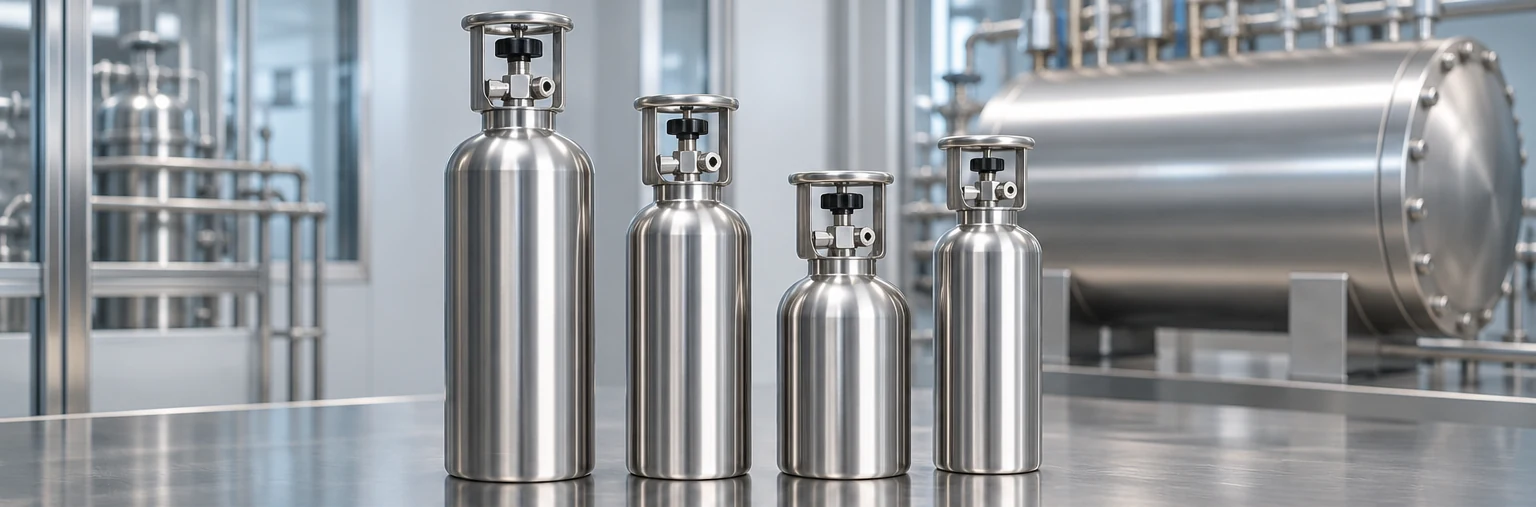
1. What Is Electropolishing in High-Purity Cylinder Manufacturing?
Electropolishing, commonly abbreviated as EP, is an electrochemical metal finishing process that removes a controlled amount of material from a conductive metal surface. Unlike conventional polishing, which relies on abrasive contact, electropolishing uses electrical energy and an electrolyte to dissolve surface material under controlled conditions.
The component being treated functions as the anode in an electrochemical system. Under suitable processing conditions, microscopic surface projections are preferentially removed, producing a smoother surface profile and reducing certain imperfections left by machining, forming, or mechanical polishing.
For specialty gas cylinders, the principal engineering interest is the condition of the internal chemical-contact surface. An attractive exterior finish may improve appearance and handling, but it tells us very little about the cleanliness or chemical behavior of the internal wall.
We therefore distinguish between external finishing and internal surface engineering. A cylinder can have a highly polished exterior while requiring substantial additional treatment inside before it becomes suitable for a contamination-sensitive application.
What Electropolishing Changes on a Stainless Steel Surface
A properly selected electropolishing process can influence several surface characteristics simultaneously:
- Microscopic surface roughness and irregularities.
- Residual surface contamination associated with earlier manufacturing operations.
- The composition and condition of the passive oxide film.
- The accessibility of surface features during subsequent cleaning.
- The distribution of certain microscopic surface imperfections.
These changes do not occur independently of the underlying material. Stainless steel composition, metallurgical cleanliness, initial surface condition, and fabrication history all affect the final result.
A cylinder manufactured from unsuitable material cannot be made chemically compatible simply by electropolishing its internal surface. Similarly, electropolishing cannot repair structural defects, compensate for inadequate wall thickness, or establish a pressure rating.
For our engineering evaluations, electropolishing is one element of a complete containment system. Its effectiveness must be assessed against the actual chemical medium and the customer’s acceptance criteria.
2. Why Internal Surface Quality Matters More Than Appearance
The internal wall of a specialty cylinder remains in contact with its contents throughout storage, transportation, and dispensing. Depending on the application, that contact may continue for an extended period, allowing even relatively small surface-related interactions to become significant.
Conventional industrial gas applications often tolerate surface conditions that would be unacceptable for electronic-grade chemicals. The difference is not necessarily the operating pressure or cylinder capacity. It is frequently the amount and type of contamination that the process can tolerate.
We evaluate internal surfaces by considering how they could influence the chemical during its intended service life, rather than judging the vessel by its appearance immediately after manufacturing.
Particle Contamination
Metal fabrication can introduce microscopic particles through cutting, machining, grinding, welding, and mechanical finishing. Some particles are easily removed during cleaning. Others may become lodged within surface grooves or remain attached to irregular features.
When a cylinder is filled, transported, or emptied, residual particles may become mobilized. The extent of this risk depends on the surface condition, chemical medium, flow behavior, and effectiveness of final cleaning.
A smoother internal surface can make certain contaminants easier to remove. However, particle cleanliness must still be verified independently because surface roughness alone does not establish a particle count.
Metallic Contamination
Electronic chemical manufacturers may impose limits on iron, nickel, chromium, and other metallic impurities. The appropriate limits vary considerably between chemical products and downstream processes.
Metallic contamination can originate from the base material, machining residues, welding-related surface changes, valves, fittings, or chemical interactions during storage.
Electropolishing can modify the near-surface condition of suitable stainless steels and remove certain superficial contaminants. It does not eliminate the possibility of metal release from an incompatible material or poorly controlled chemical environment.
Where metallic contamination represents a critical product requirement, we recommend agreeing on chemical-specific analytical methods instead of relying exclusively on a surface finish specification.
Moisture and Oxygen Contamination
Moisture and oxygen are particularly important when cylinders are intended for chemicals that are sensitive to atmospheric exposure.
Water molecules can interact with metal oxide surfaces, while retained moisture may remain within difficult-to-clean connections, internal features, or insufficiently dried assemblies. Oxygen can also enter the containment system through inappropriate handling or inadequate sealing.
Electropolishing can support the preparation of a surface that is easier to clean, but it is not a substitute for controlled drying, atmospheric protection, or suitable valve selection.
For this reason, we consider the internal finish and the condition of the cylinder at delivery to be separate, equally important manufacturing requirements.
3. Understanding Surface Roughness: What Ra Actually Measures
Surface roughness is one of the most frequently specified characteristics of electropolished stainless steel cylinders. The parameter most commonly encountered in procurement documents is Ra, the arithmetic average of the absolute deviations of a measured surface profile from its mean line under defined measurement conditions.
Ra is typically expressed in micrometers, written as µm, or microinches, written as µin. Lower Ra values generally indicate smaller average surface deviations.
Nevertheless, Ra describes only one aspect of surface topography. It does not directly measure contamination, corrosion resistance, oxide film chemistry, or the deepest individual surface defect.
Two cylinders can have identical average roughness readings while exhibiting substantially different surface characteristics.
Surface Roughness Conversion and Procurement Reference
| Ra (µm) | Approximate Ra (µin) | Engineering Interpretation |
|---|---|---|
| 0.80 | 31.50 | May be considered for less demanding service where contamination limits permit. |
| 0.40 | 15.75 | A controlled finish that may satisfy selected chemical containment requirements. |
| 0.25 | 9.84 | Upper end of the specified EP roughness range for selected KUNVESS small cylinders. |
| 0.20 | 7.87 | Specified maximum Ra for selected KUNVESS large EP cylinder configurations. |
| 0.10 | 3.94 | A fine surface finish requiring appropriate material preparation and verification. |
| 0.07 | 2.76 | Lower end of the specified EP roughness range for selected KUNVESS small cylinders. |
Conversion basis: 1 µm equals approximately 39.3701 µin. The engineering interpretations are illustrative, not universal surface finish classifications. KUNVESS specifications apply only to the relevant equipment configurations.
Why the Lowest Ra Is Not Always the Right Specification
It is understandable for buyers to request the smoothest available internal surface. However, increasingly restrictive roughness requirements may demand additional material preparation, specialized tooling, longer processing, and more extensive inspection.
Those requirements are justified when they address a measurable contamination risk. They are less useful when the chemical specification does not establish a relationship between surface roughness and product quality.
A cylinder with Ra 0.10 µm is not automatically twice as clean as one with Ra 0.20 µm. Nor does that difference demonstrate a corresponding improvement in corrosion resistance or chemical shelf life.
We recommend establishing the roughness limit together with particle cleanliness, material compatibility, residual moisture, and sealing requirements. This provides a much more meaningful basis for technical acceptance.
Measurement Location Matters
Surface roughness is particularly challenging to characterize inside closed or narrow-neck cylinders. A reading obtained from an accessible cylindrical wall may not represent the condition of a shoulder, internal weld, nozzle transition, or recessed connection.
Where direct access is limited, representative test coupons may form part of a qualified manufacturing and inspection approach. However, a coupon does not automatically establish that every internal surface has achieved the same finish.
Buyers should identify whether the specified Ra value applies to individual measurement locations, the maximum recorded reading, or another agreed acceptance method. This distinction becomes important when comparing inspection reports from different suppliers.
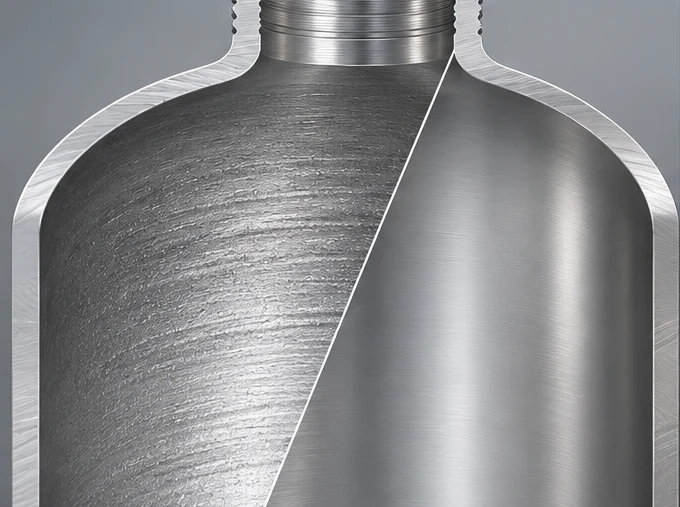
4. What Published Research Tells Us About Electropolishing
Electropolishing performance depends heavily on the original condition of the stainless steel and the way the treatment is controlled. Published research provides useful evidence for understanding these relationships, although laboratory results must not be interpreted as guaranteed performance for finished pressure vessels.
Research Finding: Initial Surface Condition Influences Final Roughness
A 2023 study published in Materials examined the relationship between processing variables, initial roughness, dimensional accuracy, and electrical consumption during the electropolishing of AISI 316L stainless steel.
For specimens with initial Ra values between 0.5 and 0.8 µm, the researchers achieved a minimum final roughness of approximately 0.035 µm and reported maximum roughness reductions approaching 90% under the investigated conditions.[1]
| Research Parameter | Reported Result |
|---|---|
| Test material | AISI 316L stainless steel |
| Initial roughness of the finer test group | Ra 0.5–0.8 µm |
| Minimum final roughness | Approximately 0.035 µm |
| Maximum roughness reduction | Approximately 90% |
The findings reinforce an important manufacturing principle: the condition of the substrate before electropolishing influences the achievable result. Extending the finishing process is not necessarily an effective substitute for proper preliminary surface preparation.
These experimental results were obtained from research specimens rather than complete specialty gas cylinders. They should not be used as a commercial cylinder acceptance specification.
Research Finding: More Aggressive Treatment Does Not Necessarily Produce a Smoother Surface
A separate 2025 investigation of current density and corrosion behavior in electropolished 316L stainless steel reported a minimum experimental Ra value of 0.229 µm within the tested groups.[2]
The study examined how changes in electropolishing conditions affected surface quality and corrosion characteristics. Its results illustrate why manufacturing parameters must be established for the specific material and processing arrangement rather than selected solely to maximize material removal.
Research involving stainless steel tubes, published in 2024, also identified electrolyte contamination as an important influence on finishing quality.[3]
From a manufacturing standpoint, these studies support the need for process consistency, appropriate initial surface preparation, and verification of the finished component. No single experimental roughness value can establish the performance of every cylinder geometry or chemical application.
5. Mechanical Polishing vs. Electropolishing vs. Chemical Passivation
Mechanical polishing, electropolishing, and chemical passivation are frequently mentioned together in stainless steel equipment specifications. Although the treatments can complement one another, they address different surface conditions.
Confusing these methods can result in procurement specifications that describe a desired appearance without establishing the functional surface characteristics needed for high-purity service.
Mechanical Polishing
Mechanical polishing removes material through controlled abrasive action. It is particularly useful for reducing visible machining marks, smoothing accessible transitions, and preparing surfaces for further finishing.
The effectiveness of mechanical polishing depends on abrasive selection, access, workmanship, and subsequent residue removal. Improperly controlled finishing may introduce embedded particles or leave directional scratches.
We evaluate mechanical polishing as a standalone treatment where the application permits it, or as part of the preparation required before electropolishing.
Electropolishing
Electropolishing removes surface metal electrochemically. The process can reduce microscopic irregularities without introducing the same direct abrasive contact associated with mechanical polishing.
Because it changes the near-surface metal condition, electropolishing can also contribute to passivation when properly applied to suitable stainless steel.
ASTM B912 specifically addresses stainless steel passivation through electropolishing.[4] Its relevance must be established within the project specification rather than assumed from the presence of an EP finish.
Chemical Passivation
Chemical passivation is intended to improve the passive condition of suitable stainless steel surfaces, including the removal of certain free-iron contamination.
Unlike electropolishing, chemical passivation is not primarily a surface leveling process. A passivated cylinder may retain essentially the same machining grooves and roughness profile that existed before treatment.
ASTM A967/A967M provides requirements for chemical passivation treatments of stainless steel parts.[5]
| Selection Criterion | Mechanical Polishing | Electropolishing | Chemical Passivation |
|---|---|---|---|
| Primary mechanism | Abrasive material removal | Electrochemical dissolution | Chemical surface treatment |
| Surface leveling | Dependent on abrasive process and access | Targets microscopic irregularities | Not the principal objective |
| Deep machining marks | Can address accessible marks through controlled finishing | May require prior mechanical preparation | Generally does not remove them |
| Passive surface condition | Additional treatment may be necessary | Can support passivation under appropriate conditions | Primary treatment objective |
| Dimensional considerations | Material removal must be controlled | Material removal must be included in dimensional control | Generally less dimensional influence than leveling treatments |
| Typical purchasing rationale | Surface preparation or suitable conventional service | Contamination-sensitive stainless steel containment | Removal of free-iron contamination and passive surface preparation |
| Final cleanliness verification | Required as specified | Required as specified | Required as specified |
Our engineering recommendation is to specify the required surface condition and associated acceptance tests before choosing the treatment sequence. Different combinations of mechanical finishing, electropolishing, passivation, and precision cleaning may be appropriate for different chemicals.
6. How Electropolishing Influences Stainless Steel Corrosion Resistance
Stainless steel derives much of its corrosion resistance from a thin, spontaneously formed passive oxide film. Chromium plays a central role in the development of this protective surface.
The condition of the passive film can be affected by manufacturing operations, contamination, thermal exposure, and chemical service conditions. Electropolishing can modify the near-surface composition and support a more favorable passive condition when suitable processing parameters are used.
Research reviewing electrochemical polishing of austenitic stainless steels describes improvements in surface finish and corrosion behavior under appropriate treatment conditions.[6]
However, corrosion resistance must always be understood in relation to a specific chemical environment.
General Corrosion
General corrosion involves material degradation across a relatively broad exposed surface. Its severity depends on the compatibility of the metal with the chemical, along with concentration, temperature, impurities, and exposure conditions.
Electropolishing may improve the initial surface condition, but it cannot convert an inherently incompatible stainless steel into a suitable containment material.
Pitting and Crevice Corrosion
Pitting corrosion involves localized attack that can penetrate the metal even when the surrounding surface appears unaffected. Crevice corrosion is associated with restricted geometries where local chemical conditions differ from those of the surrounding environment.
Internal connections, gasket interfaces, recessed features, and certain weld geometries deserve particular attention because their corrosion behavior may differ from that of an unobstructed cylindrical wall.
A smooth internal finish is beneficial only when these features are also evaluated. We do not consider a low roughness reading from an accessible area sufficient evidence of complete resistance to localized corrosion.
When Electropolishing Is Not Enough
Some chemical environments require alternative alloys, compatible protective linings, specialized surface treatments, or different containment designs.
Where compatibility is uncertain, our recommendation is to resolve the material selection question before investing in an increasingly restrictive stainless steel surface finish.
ISO 11114-1 addresses compatibility between metallic cylinder and valve materials and gas contents.[7] Its application depends on the equipment and service involved. A general material compatibility reference should not replace chemical-specific engineering assessment.
7. Why Material Selection Comes Before Electropolishing
The quality of an electropolished surface begins with the quality of the metal from which it is produced.
Nonmetallic inclusions, material discontinuities, fabrication defects, and uneven microstructures may become apparent during surface treatment. Removing a superficial layer does not eliminate defects extending beneath that layer.
For sensitive chemical containment applications, material selection should therefore consider metallurgical cleanliness as well as nominal alloy composition.
Within our specialty cylinder product families, material options include 316L, 316LV, 316LVV, and other application-specific materials. Availability depends on the selected equipment configuration.
| Material | When to Evaluate It | What Buyers Should Verify |
|---|---|---|
| 316L stainless steel | Compatible chemical service with defined cleanliness requirements | Material standard, product form, chemical compatibility, and final surface condition |
| 316LV | Applications requiring additional control of material cleanliness or trace impurities | Approved material specification, refining requirements, and material certificates |
| 316LVV | Highly sensitive applications requiring additional material qualification | Contractual material requirements, metallurgical acceptance criteria, and traceability |
| 304 stainless steel | Compatible service where its material properties satisfy the application | Chemical compatibility and suitability for the intended pressure equipment design |
| Alternative alloys or lined configurations | Applications where conventional stainless steel may be unsuitable | Medium-specific compatibility and qualification of the complete containment system |
The terms 316LV and 316LVV should be supported by an agreed material specification. Buyers should not assume that these designations establish identical refining routes, inclusion limits, or trace-element requirements across all suppliers.
We recommend reviewing our detailed explanation of the differences between 316L and 316LV stainless steel when developing specifications for electronic chemical containment.
8. Engineering Electropolished Cylinders for Semiconductor Chemicals
Semiconductor chemical packaging presents a demanding combination of contamination control, chemical compatibility, sealing integrity, and consistent dispensing requirements.
The economic consequences of contamination can extend beyond the value of the chemical itself. Investigation, material disposal, equipment cleaning, production interruptions, and process requalification may all contribute to the cost of a contamination event.
For these applications, the cylinder should be evaluated as part of the chemical supply system rather than as an isolated storage vessel.
Electronic Specialty Gases
Electronic specialty gases may require tightly controlled limits for oxygen, moisture, hydrocarbons, particles, or other impurities. The relevant contamination profile depends on the gas and the process it supports.
Internal surface preparation can help reduce contamination associated with the cylinder. Nevertheless, gas purity also depends on the quality of the incoming gas, filling equipment, connections, and subsequent handling.
We recommend defining these interfaces before finalizing the cylinder specification.
Liquid Semiconductor Precursors
Liquid precursors present different contamination and delivery challenges from conventional compressed gases. Liquid contact with the internal wall, residual chemical retention, dispensing geometry, and compatibility with sealing materials can all influence suitability.
Our selected small electropolished cylinder models include configurations intended for TEOS, TEB, and certain metal-organic source materials.
Each proposed application must still be evaluated against the actual formulation, operating conditions, chemical sensitivity, and applicable containment requirements.
Different Chemicals Require Different Qualification Priorities
| Application | Potential Contamination Concern | Priority Engineering Review |
|---|---|---|
| Electronic specialty gases | Moisture, oxygen, particles, and other trace impurities | Internal cleanliness, leak integrity, valve compatibility, and gas-specific requirements |
| TEOS packaging | Moisture exposure and chemical contamination | Material compatibility, internal finish, drying, and dispensing configuration |
| TEB and selected metal-organic precursors | Chemical sensitivity and incompatible contact materials | Complete material and sealing compatibility assessment |
| Bulk electronic chemicals | Large-area surface contamination and residual impurities | Internal surface coverage, cleaning verification, and delivery condition |
| Research and analytical gases | Adsorption, desorption, and changes in trace composition | Gas-specific surface treatment and stability qualification |
These considerations are not chemical compatibility approvals or operating instructions. Final equipment selection must be based on the actual medium, safety data, and qualified engineering assessment.
9. Manufacturing Challenges Inside Closed Cylinders
Electropolishing a flat stainless steel specimen is considerably different from treating the interior of a finished cylindrical pressure vessel.
Flat specimens provide relatively straightforward access for processing and inspection. A closed cylinder introduces curved surfaces, restricted openings, changes in cross-section, and areas that may be difficult to inspect directly.
These geometric differences affect how we evaluate the feasibility of internal finishing.
Cylinder Geometry and Surface Accessibility
The shoulder, bottom transition, and neck of a cylinder may present different finishing challenges from the main cylindrical body.
Even when an electrochemical finishing process is properly established for a particular alloy, the distribution of treatment across a complex internal geometry requires separate consideration.
Our approach is to evaluate the cylinder dimensions, access openings, manufacturing sequence, and required inspection coverage before confirming the final surface specification.
Welded Joints and Heat-Affected Surfaces
Where welded construction is used, weld geometry and the surrounding heat-affected material may influence the internal surface condition.
Surface discoloration, irregular weld profiles, and fabrication-related contamination must be addressed through suitable manufacturing and finishing procedures.
Electropolishing is not a means of repairing unacceptable weld defects. Structural acceptance and surface finishing remain separate engineering responsibilities.
Precision Interfaces and Dimensional Control
Threads, sealing faces, valve connections, and precision-machined interfaces have dimensional requirements that may be affected by material removal.
A finishing process that improves the appearance of a component but changes a critical sealing dimension can create a functional problem elsewhere in the assembly.
We therefore evaluate finishing requirements alongside the dimensional tolerances established in the approved engineering drawings.
Our pressure vessel manufacturing technology includes precision machining, forming, welding, mechanical finishing, electropolishing, and specialized cleaning selected according to the application.
10. Why Precision Cleaning Must Follow Surface Finishing
A newly electropolished surface is not necessarily ready for high-purity chemical service.
Electrolyte residues, dissolved metal compounds, processing liquids, and contaminants introduced during handling must be adequately removed before the cylinder can satisfy its final cleanliness requirements.
The effectiveness of this preparation is particularly important in narrow-neck vessels and assemblies containing difficult-to-access internal features.
Removing Manufacturing Residues
Internal cleaning must address the types of contamination introduced by the manufacturing and finishing sequence. The appropriate treatment depends on whether the principal concerns are oils, particles, ionic residues, moisture, or other substances.
ASTM A380/A380M provides relevant practices for cleaning, descaling, pickling, and passivation of stainless steel equipment.[8]
The final cleaning specification for a high-purity cylinder may require additional chemical-specific acceptance criteria beyond general stainless steel preparation practices.
Drying and Internal Protection
Removing visible liquid is not equivalent to demonstrating that a cylinder satisfies a trace-moisture requirement. Residual moisture may persist at surface features or within connected components.
Selected KUNVESS large high-purity cylinder configurations incorporate high-purity deionized water cleaning and high-purity nitrogen drying as part of their internal preparation requirements.
For these configurations, the specified target for residual moisture and oxygen is 0.5 ppm or less, subject to the agreed cleanliness specification and verification method.
That target describes a specified cylinder preparation condition. It does not establish the final purity of the chemical subsequently introduced by a filling facility.
Protecting the Surface After Cleaning
Once the internal surface has been prepared, uncontrolled exposure can undermine the work already completed. Valve installation, protective closures, storage conditions, and delivery arrangements should preserve the specified internal condition.
We recommend discussing the required delivery condition during quotation rather than assuming that every electropolished cylinder will arrive ready for immediate filling.
11. Representative KUNVESS Electropolished Cylinder Specifications
We manufacture specialty cylinders across several capacity ranges. The appropriate product family depends on chemical properties, required volume, working pressure, internal cleanliness, and connection requirements.
For buyers who require a technical starting point, the following figures identify selected EP configurations and their associated specifications.
| Parameter | Selected Small EP Cylinders | Selected Large High-Purity Configurations |
|---|---|---|
| Product family capacity | 0.5–150 L | 150–1,000 L |
| Product family pressure range | 0.1–10 MPa | 0.1–10 MPa |
| Internal surface treatment | Electropolishing on applicable models | Electropolishing on specified configurations |
| Internal surface roughness | Ra 0.07–0.25 µm | Ra ≤ 0.20 µm |
| Helium leak rate | ≤ 1 × 10⁻⁹ Pa·m³/s for selected models | Project-specific acceptance requirements |
| Residual moisture and oxygen | Project-specific acceptance requirements | Specified target ≤ 0.5 ppm for applicable configurations |
| Valve and fitting configuration | Application-specific | Application-specific |
| Certification and approval | Subject to selected model and application | Subject to selected model and application |
Capacity and pressure ranges describe product families, not simultaneous ratings for every model. Surface finish, cleanliness, material, pressure rating, and approval scope must be confirmed for the selected configuration.
For compact semiconductor chemical packaging, our small specialty gas cylinders include selected EP models with capacities of 500 mL, 1.5 L, 1.98 L, 2.5 L, 5 L, and 7 L.
For bulk chemical applications, our large specialty gas cylinders provide additional capacity options, including configurations intended for demanding internal cleanliness requirements.
Intermediate applications can be evaluated within our medium specialty cylinder product family.
12. How to Verify the Quality of an Electropolished Cylinder
One of the most useful purchasing practices is to separate the different characteristics that must be verified before accepting a high-purity cylinder.
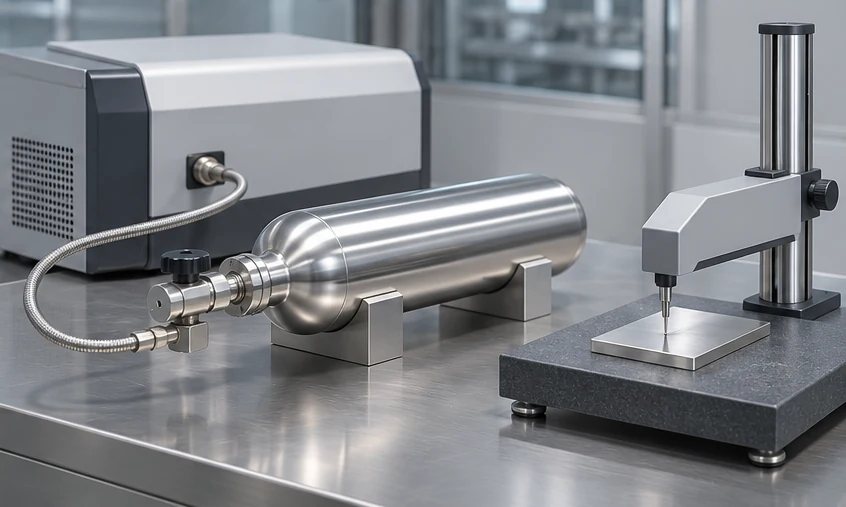
A roughness report establishes information about surface topography. A helium leak test evaluates leakage under defined test conditions. Neither independently demonstrates the absence of chemical contamination.
We recommend matching every critical product requirement with a corresponding verification method.
| Inspection | What It Evaluates | What It Does Not Independently Establish |
|---|---|---|
| Material certificate review | Specified material identity and documented properties | Final internal cleanliness |
| Surface roughness measurement | Surface profile at defined measurement locations | Particle count or complete surface chemistry |
| Internal visual inspection | Accessible scratches, discoloration, and visible defects | Trace chemical contamination |
| Helium leak testing | Leakage under specified test conditions | Structural pressure rating or chemical purity |
| Moisture and oxygen analysis | Specified atmospheric impurities under defined conditions | All possible chemical or metallic contaminants |
| Particle testing | Particle contamination according to an agreed method | Dissolved metal concentrations |
| Pressure and structural inspection | Specified mechanical integrity requirements | Suitability for ultra-high-purity service |
| Application-specific chemical analysis | Defined extractable or released contaminants | Universal compatibility with unrelated chemicals |
Understanding the Helium Leak Rate
Selected KUNVESS small EP cylinders specify a helium leak rate of no more than 1 × 10⁻⁹ Pa·m³/s.
This is equivalent to 1 × 10⁻⁸ mbar·L/s as a unit conversion. However, the numerical limit must be interpreted together with the test arrangement, pressure conditions, equipment configuration, and acceptance method.
A test performed on a cylinder body alone may not establish the leakage performance of the complete cylinder and valve assembly.
Our quality control and certification capabilities include material evaluation, helium leak detection, surface inspection, and application-specific contamination analysis. The final inspection package should be agreed before manufacturing begins.
13. Which Standards Apply to Electropolished High-Purity Cylinders?
Different technical standards address different aspects of equipment performance. A reference covering stainless steel passivation does not establish pressure vessel approval, while a pressure equipment approval does not necessarily establish high-purity surface acceptance.
Buyers should avoid treating these requirements as interchangeable.
| Standard or Framework | Principal Subject | Procurement Consideration |
|---|---|---|
| ASTM B912 | Passivation of stainless steels through electropolishing | Specify applicable process and acceptance requirements. |
| ASTM A967/A967M | Chemical passivation treatments | Determine whether separate chemical passivation requirements apply. |
| ASTM A380/A380M | Stainless steel cleaning and surface preparation practices | Establish appropriate cleaning and preparation requirements. |
| SEMI F19 | Surface condition of stainless steel wetted components | Evaluate applicability to semiconductor chemical-contact surfaces. |
| SEMI F20 | 316L stainless steel product forms for semiconductor components | Review material requirements and applicable product forms. |
| ISO 11114-1 | Compatibility of metallic cylinder and valve materials with gas contents | Review applicability to the intended chemical and containment design. |
| ASME, UN, DOT, and TPED-related requirements | Applicable pressure equipment design or transport approval frameworks | Confirm the specific equipment category, approved design, and certification scope. |
SEMI F19 and SEMI F20 are particularly relevant when evaluating stainless steel chemical-contact components for semiconductor manufacturing.[9][10]
The inclusion of these references does not constitute a declaration that every KUNVESS cylinder conforms to every listed standard. Contractual requirements, applicable editions, and model-specific documentation must be established separately.
14. Does Electropolishing Increase Cylinder Manufacturing Costs?
Electropolishing generally introduces additional manufacturing costs because the process requires surface preparation, specialized equipment, process control, cleaning, inspection, and protection of the finished surface.
The actual cost difference cannot be determined from cylinder capacity alone. Geometry, material condition, internal accessibility, acceptance limits, and documentation requirements may influence the quotation more substantially than the nominal vessel size.
What Determines the Additional Cost?
| Cost Factor | Why It Affects Manufacturing | Recommended Purchasing Approach |
|---|---|---|
| Stainless steel grade | Specialized material requirements may increase acquisition and qualification costs. | Specify additional metallurgical controls only where justified. |
| Internal geometry | Restricted access can require specialized processing arrangements. | Review the design and finish requirements together. |
| Initial surface condition | Additional preparation may be needed before electropolishing. | Establish an appropriate manufacturing sequence. |
| Final roughness limit | More restrictive acceptance limits may require additional processing and measurement. | Connect the finish requirement to actual contamination risk. |
| Cleanliness requirements | Specialized cleaning, drying, and analysis introduce additional work. | Define the specific impurities that must be controlled. |
| Inspection and documentation | Additional testing and third-party inspection may affect cost and lead time. | Agree on the required documentation before quotation. |
Evaluating the Investment Without Inventing Savings
The commercial value of an EP cylinder depends on whether its additional manufacturing cost addresses a meaningful operating risk or reduces another measurable expense.
A procurement evaluation can compare the acquisition cost of the cylinder with its expected cleaning, qualification, inspection, maintenance, and contamination-related expenses over the intended service period.
Total lifecycle cost = acquisition cost + qualification cost + cleaning and maintenance cost + applicable inspection cost + expected contamination-related cost.
The expected contamination-related cost should be estimated using the buyer’s own validated operating data. Without reliable contamination probabilities and financial consequences, a percentage savings claim would be speculative.
We encourage buyers to evaluate whether the additional surface treatment supports a defined chemical purity requirement. Where contamination consequences are substantial, additional manufacturing and verification costs may be entirely reasonable.
15. When Electropolishing Is Worth Specifying—and When It May Not Be
Electropolishing deserves serious consideration when the cylinder is intended for contamination-sensitive chemicals, particularly where surface-related impurities can compromise downstream processing.
However, the presence of stainless steel does not automatically justify electropolishing. The finishing method should reflect the actual application.
Applications That Warrant Further EP Evaluation
- Electronic-grade gas packaging with restrictive impurity limits.
- Semiconductor precursor containment requiring controlled internal cleanliness.
- Specialty chemicals with defined metallic contamination requirements.
- Analytical applications where surface interactions may influence sample composition.
- Reusable high-purity chemical containers requiring qualified cleaning procedures.
Applications Where Another Finish May Be Sufficient
Mechanical polishing or another suitable treatment may satisfy applications where chemical compatibility is established and contamination limits do not require a finer electropolished surface.
For certain corrosive chemicals, selecting an appropriate alloy or qualified lining may be a more important engineering decision than further reducing stainless steel roughness.
We recommend avoiding blanket surface finish requirements across an entire cylinder inventory. Establishing different equipment specifications for different chemical services can improve technical consistency and purchasing efficiency.
16. An Illustrative Engineering Selection Scenario
Consider a chemical supplier evaluating two new stainless steel cylinder configurations for a contamination-sensitive liquid precursor.
The first proposal specifies a mechanically polished internal surface. The second specifies an electropolished surface, additional cleaning, and defined leak acceptance requirements.
The second proposal appears more comprehensive, but the comparison remains incomplete until both suppliers identify the relevant material specification, internal surface coverage, valve configuration, and final cleanliness verification.
If the chemical supplier’s principal concern is metallic contamination, the procurement documents should identify the elements of concern and the agreed analytical method. If moisture is the dominant concern, the cylinder preparation and delivery condition deserve additional attention.
Where sealing integrity is especially important, leak testing should cover the relevant assembly rather than an unspecified portion of the vessel.
This example illustrates how a purchasing decision becomes more defensible when the specification is derived from actual chemical requirements. It is a hypothetical engineering scenario, not a reported customer project or measured KUNVESS performance result.
17. Maintaining Electropolished Cylinders During Reuse
An electropolished surface should not be regarded as permanently protected against contamination or degradation.
Repeated chemical exposure, incompatible cleaning agents, mechanical damage, inappropriate handling, and uncontrolled atmospheric exposure can change the internal condition over time.
For reusable cylinders, inspection and maintenance requirements should consider the chemical service history and the applicable equipment regulations.
We recommend maintaining appropriate cylinder identification, chemical service records, inspection documentation, and approved cleaning records where required by the application.
Re-electropolishing may be considered for suitable equipment after engineering assessment. Because the treatment removes metal, the effects on wall thickness, critical dimensions, structural integrity, and approval validity must be evaluated before additional processing.
Cylinders containing or previously exposed to hazardous chemicals must only be serviced by qualified personnel using approved procedures.
18. How to Specify an Electropolished Cylinder When Requesting a Quote
A technically complete request for quotation reduces the likelihood of receiving equipment proposals based on different assumptions.
At KUNVESS, we recommend providing the following information when requesting a high-purity specialty cylinder:
- Chemical medium: chemical name, composition, concentration, physical state, and applicable safety data.
- Capacity: required internal volume and intended filling requirements.
- Pressure conditions: specified working pressure and relevant design requirements.
- Temperature conditions: anticipated storage, transportation, and operating temperatures.
- Material: preferred stainless steel grade or approved material specification.
- Internal finish: required EP treatment and maximum acceptable surface roughness.
- Cleanliness: moisture, oxygen, particle, metallic impurity, and other relevant acceptance limits.
- Connections: valve interfaces, fittings, sealing materials, and dispensing configuration.
- Verification: inspection methods, measurement locations, sampling requirements, and acceptance criteria.
- Documentation: material certificates, applicable inspection reports, and equipment-specific approvals.
- Delivery condition: required internal protection, packaging, and preservation arrangements.
Where a requirement has not yet been established, identify it as subject to technical review rather than assigning an arbitrary numerical value. This allows us to evaluate a suitable manufacturing solution without introducing unnecessary restrictions.
19. Choosing a Qualified Electropolished Cylinder Manufacturer
The ability to produce a reflective stainless steel surface is not sufficient evidence that a manufacturer can deliver high-purity pressure equipment.
A meaningful supplier assessment should consider the manufacturer’s ability to integrate material selection, pressure vessel fabrication, internal surface finishing, chemical cleanliness, and documented inspection.
| Evaluation Area | Evidence to Request |
|---|---|
| Material engineering | Approved material specifications and traceability arrangements |
| Pressure vessel design | Technical drawings and applicable design documentation |
| Electropolishing capability | Applicable internal finish specifications and verification methods |
| Precision cleaning | Agreed cleanliness requirements and associated inspection methods |
| Leak integrity | Defined leak test scope, conditions, and acceptance criteria |
| Regulatory documentation | Model-specific approval and certification records where required |
| Customization | Engineering review of material, geometry, valves, and customer specifications |
Working With KUNVESS
Our manufacturing capabilities bring together specialty cylinder production, precision metal processing, application-specific material selection, electropolishing, and specialized internal cleaning.
We offer small, medium, and large specialty cylinder configurations, allowing us to evaluate different containment volumes and delivery arrangements according to the customer’s technical requirements.
Selected small EP models specify internal surface roughness from Ra 0.07 to 0.25 µm and helium leak rates of 1 × 10⁻⁹ Pa·m³/s or less. Selected large high-purity configurations specify an EP internal finish of Ra 0.20 µm or less.
These specifications provide a useful starting point for engineering discussions. Final manufacturing commitments are established through the approved design, application requirements, quotation, and inspection criteria.
If you are evaluating a new chemical packaging system, replacing existing specialty cylinders, or developing a custom high-purity containment solution, contact our engineering team to discuss the required material, internal surface treatment, and technical acceptance conditions.
Conclusion: Electropolishing Is Part of a Complete Purity-Control Strategy
The value of electropolishing lies in its ability to improve the chemical-contact surface of a suitable metal cylinder. Properly applied, it reduces microscopic irregularities, supports surface cleanability, and contributes to an appropriate passive surface condition.
Its limitations are equally important. Electropolishing does not independently establish chemical compatibility, structural integrity, leak-tightness, or final chemical purity.
At KUNVESS, we approach high-purity cylinder manufacturing through the combined evaluation of material quality, fabrication, internal finish, precision cleaning, sealing performance, and documented acceptance requirements.
The most suitable cylinder is not necessarily the one with the lowest numerical roughness value. It is the one whose complete material and manufacturing specification addresses the chemical’s actual requirements and whose performance can be verified through appropriate inspection.
Frequently Asked Questions
1. Why is electropolishing important for high-purity cylinders?
Electropolishing reduces microscopic surface irregularities and supports the preparation of cleaner, more chemically stable stainless steel surfaces. It is particularly useful for contamination-sensitive specialty gases and semiconductor chemicals. Final cleanliness, chemical compatibility, and leak integrity must still be verified separately.
2. What surface roughness is suitable for a high-purity gas cylinder?
The appropriate roughness depends on the chemical medium and contamination requirements. Selected KUNVESS small electropolished cylinders specify Ra 0.07–0.25 µm, while selected large high-purity configurations specify Ra 0.20 µm or less. These are configuration-specific specifications rather than universal industry requirements.
3. Is electropolishing better than mechanical polishing?
Electropolishing can provide advantages for contamination-sensitive stainless steel surfaces by reducing microscopic irregularities through electrochemical material removal. Mechanical polishing remains useful for preliminary surface preparation and suitable conventional applications. The correct treatment depends on the initial surface condition and required acceptance criteria.
4. Does electropolishing prevent stainless steel corrosion?
Electropolishing can improve the passive surface condition and corrosion behavior of suitable stainless steels under appropriate circumstances. It does not guarantee corrosion resistance against every chemical. Material compatibility, temperature, concentration, impurities, and exposure conditions must be evaluated independently.
5. Does an electropolished cylinder require additional cleaning?
Yes. Electropolishing must be followed by suitable residue removal and cleaning. High-purity applications may also require controlled drying, internal protection, and verification of moisture, oxygen, particles, or other specified contaminants before the cylinder is accepted.
6. Can an existing high-purity cylinder be electropolished again?
Re-electropolishing may be possible for suitable equipment following qualified engineering assessment. Previous chemical exposure, material condition, remaining wall thickness, dimensional tolerances, and applicable equipment approvals must be reviewed before additional material removal is authorized.
7. How much does an electropolished specialty gas cylinder cost?
Pricing depends on cylinder capacity, material grade, working pressure, internal geometry, roughness requirements, cleaning specifications, valves, and inspection documentation. A technically accurate quotation requires the chemical medium and intended operating conditions. There is no universal price premium applicable to every electropolished cylinder.
8. Can KUNVESS manufacture custom electropolished high-purity cylinders?
Yes. We evaluate custom specialty cylinder configurations according to required capacity, chemical medium, material specification, working pressure, internal finish, valve interfaces, and cleanliness requirements. Final manufacturing feasibility, technical specifications, and applicable approvals are confirmed during project review.
Related Reading
Related Products and Technical Resources
- Small Specialty Gas Cylinders
- Medium Specialty Gas Cylinders
- Large Specialty Gas Cylinders
- Pressure Vessel Manufacturing and Electropolishing Technology
- Quality Control, Testing, and Certifications
Technical References and Sources
- Electropolishing Stainless Steel Optimization Using Surface Quality, Dimensional Accuracy, and Electrical Consumption Criteria. Materials, 2023, Volume 16, Article 1770. View peer-reviewed research.
- Influence of Current Density on Electrochemical Polishing and Corrosion Behavior of 316L Stainless Steel. Surface Technology, 2025. View research article.
- Evaluation of Electropolishing Characteristics of 316L Stainless Steel Tube in Contaminated Electrolyte. Archives of Metallurgy and Materials, 2024, Volume 69. View peer-reviewed research.
- ASTM B912. Standard Specification for Passivation of Stainless Steels Using Electropolishing. ASTM standard information.
- ASTM A967/A967M-25. Standard Specification for Chemical Passivation Treatments for Stainless Steel Parts. ASTM standard information.
- Electrochemical Polishing of Austenitic Stainless Steels. Materials, 2020, Volume 13, Article 2557. View scientific review.
- ISO 11114-1:2020. Gas cylinders — Compatibility of cylinder and valve materials with gas contents — Part 1: Metallic materials. ISO standard information.
- ASTM A380/A380M-25. Standard Practice for Cleaning, Descaling, Pickling, and Passivation of Stainless Steel Parts, Equipment, and Systems. ASTM standard information.
- SEMI F19. Specification for the Surface Condition of the Wetted Surfaces of Stainless Steel Components. SEMI standard information.
- SEMI F20. Material specification covering selected 316L stainless steel product forms for semiconductor manufacturing components. SEMI stainless steel component standards.
About KUNVESS
KUNVESS specializes in manufacturing high-purity specialty gas cylinders, chemical containment equipment, UN portable tanks, specialty ISO tank containers, custom pressure vessels, and precision metal components. Our manufacturing capabilities include application-specific material selection, engineering customization, fabrication, electropolishing, specialized cleaning, and equipment inspection.
Technical Disclaimer
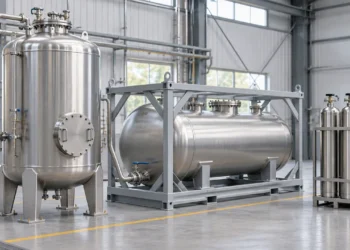
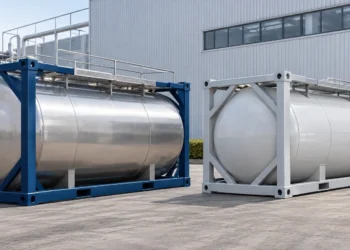
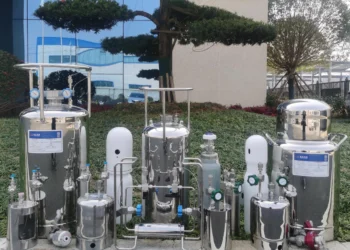
This article is intended for general engineering and procurement reference. It does not constitute a certified equipment specification, chemical compatibility approval, operating procedure, or guarantee of chemical purity. Research results cited in this article describe the specific experimental conditions investigated by their respective authors and do not represent KUNVESS product test results. Illustrative images are conceptual renderings rather than actual manufacturing or inspection photographs.
Product specifications, available materials, surface finishes, cleanliness targets, inspection methods, pressure ratings, and certification options are subject to the selected equipment design and approved contractual documentation. Hazardous chemical containment, filling, transportation, cleaning, and maintenance must be evaluated and performed by qualified personnel in accordance with applicable regulations and approved procedures.