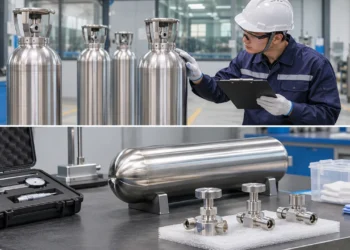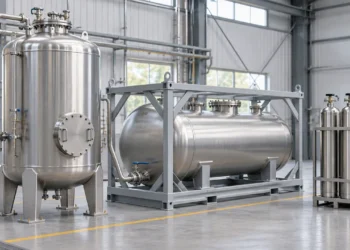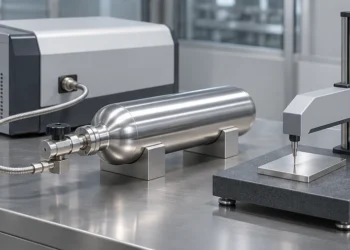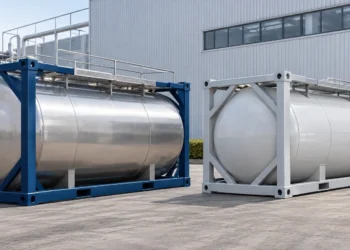
A high purity gas cylinder is a specialized pressure receptacle designed to store, transport, and deliver gases while minimizing contamination from internal metal surfaces, residual moisture, particles, and sealing components. Unlike a conventional industrial gas cylinder, its design must address both pressure containment and the chemical stability of the stored medium. Depending on the application, high-purity cylinders may also contain liquefied gases or electronic-grade liquid precursors.
At KUNVESS, we approach cylinder manufacturing as a combination of materials engineering, pressure vessel design, precision surface finishing, and contamination control. A cylinder must withstand its approved operating conditions without introducing unacceptable impurities into the material it contains. Understanding how these requirements interact helps gas suppliers, semiconductor manufacturers, and industrial equipment buyers select containment systems that protect product quality throughout filling, storage, transportation, and delivery.
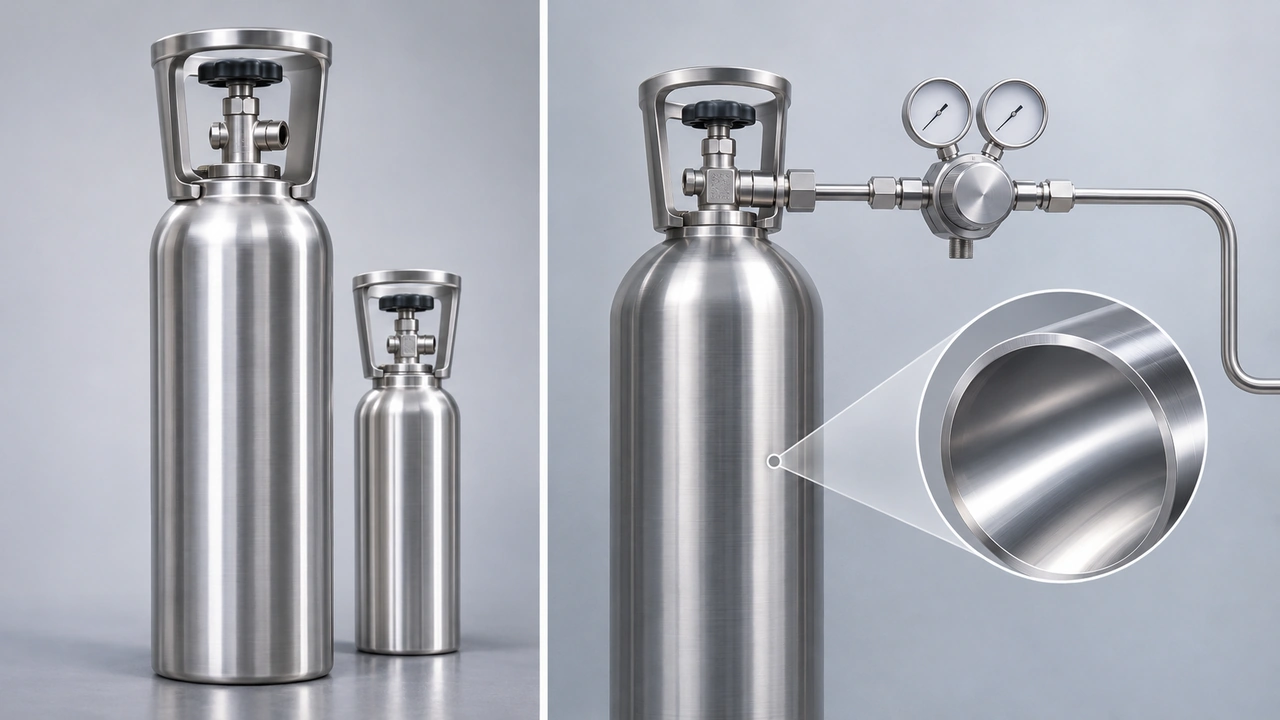
What Makes a Gas Cylinder High Purity?
A high-purity cylinder is distinguished by its ability to preserve the quality of its contents under specified service conditions. The cylinder does not produce purified gas, nor does it automatically remove contaminants already present in the supplied material. Its purpose is to limit additional contamination and maintain a suitable environment for the chemical medium.
This distinction matters because the purity of a delivered gas depends on more than the quality of the original gas supply. A gas may meet its specification immediately after purification but develop measurable contamination during filling, storage, or transfer if the packaging and delivery equipment are unsuitable.
For ordinary industrial applications, pressure integrity and material compatibility may dominate the cylinder specification. Semiconductor processing, trace gas analysis, and electronic chemical manufacturing introduce additional concerns. Moisture adsorbed onto metal surfaces, residues left during fabrication, or unsuitable valve materials can interfere with processes operating at very low impurity tolerances.
We therefore evaluate high-purity containment through four separate engineering requirements:
- Mechanical integrity: The cylinder must safely withstand its approved pressure, temperature, and handling conditions.
- Chemical compatibility: Every material exposed to the contents must be suitable for the intended gas or liquid chemical.
- Internal cleanliness: Manufacturing residues, particles, moisture, and other contaminants must be controlled to agreed acceptance limits.
- Sealing integrity: Valves, connections, welds, and other pressure-boundary features must meet applicable leakage requirements.
These requirements cannot substitute for one another. A cylinder that passes a pressure test may still contain unacceptable surface residues. Likewise, an exceptionally clean vessel cannot be placed into service if its material or pressure rating is unsuitable for the intended chemical.
Understanding Gas Purity Grades
Gas suppliers frequently describe purity using percentages or a numerical shorthand based on the number of nines in the purity value. For example, a 5N gas has a nominal purity of 99.999%, while a 6N gas has a nominal purity of 99.9999%.
The following table converts common purity grades into their theoretical remaining impurity fractions, assuming purity and impurities are expressed on the same molar basis.
| Purity Grade | Nominal Purity | Remaining Impurity Fraction | Equivalent ppb |
|---|---|---|---|
| 3N | 99.9% | 1,000 ppm | 1,000,000 ppb |
| 4N | 99.99% | 100 ppm | 100,000 ppb |
| 5N | 99.999% | 10 ppm | 10,000 ppb |
| 6N | 99.9999% | 1 ppm | 1,000 ppb |
| 7N | 99.99999% | 0.1 ppm | 100 ppb |
These values are mathematical conversions of nominal purity percentages, not measured cylinder performance or guaranteed gas specifications. Individual impurity limits may be considerably lower than the theoretical total.
The difference between 5N and 6N purity is not merely an additional decimal place. It represents a tenfold reduction in the theoretical total impurity fraction. At these concentrations, contamination that would be insignificant in general industrial service may consume a substantial portion of the allowable impurity budget.
However, total purity alone is an incomplete purchasing specification. Two gases with identical nominal purity can contain different concentrations of water, oxygen, hydrocarbons, or other impurities. The particular contaminants affecting the customer’s process should be identified before cylinder materials and preparation methods are finalized.
How Does a High-Purity Gas Cylinder Work?
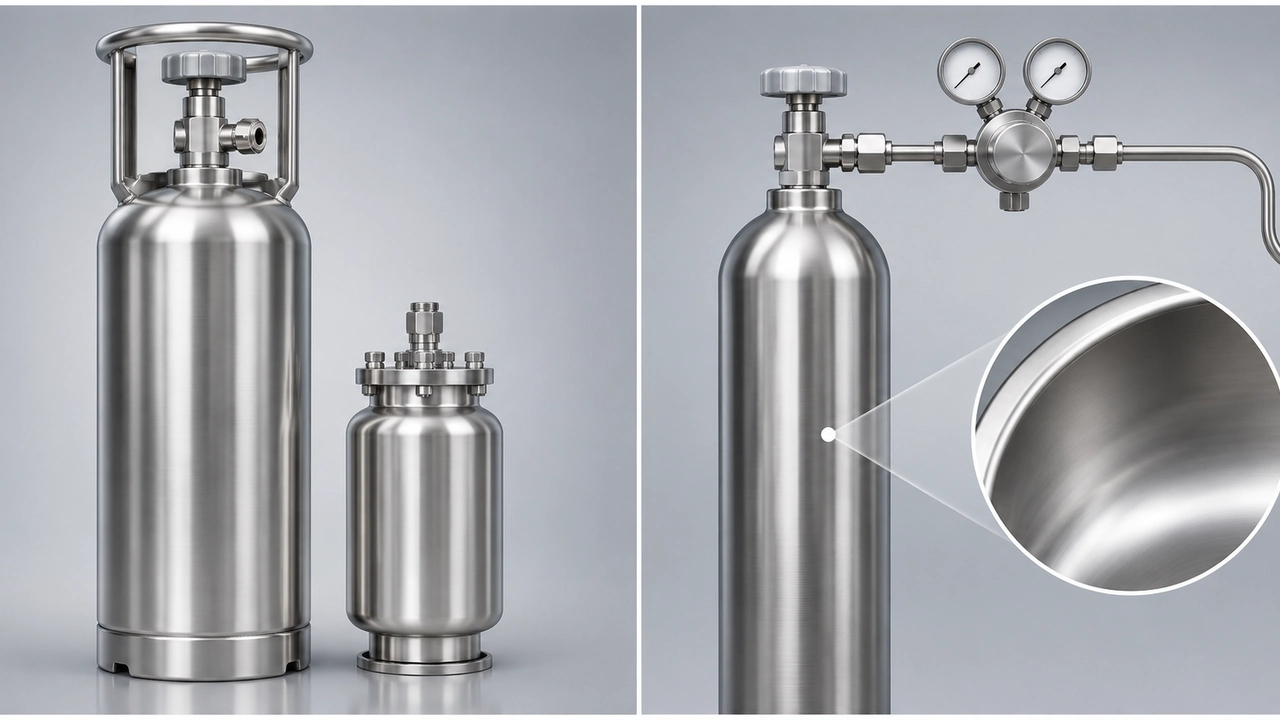
A high-purity gas cylinder works by containing a gas or chemical medium within a mechanically rated, chemically compatible pressure boundary. When connected to an approved delivery system, the cylinder supplies its contents through a controlled valve arrangement while its internal materials and prepared surfaces help limit contamination.
For conventional compressed gas service, the pressure difference between the cylinder and downstream equipment provides the driving force for gas movement. A suitable pressure regulator reduces and controls the delivery pressure, while separate flow-control equipment determines the quantity supplied to the process.
Although this operating principle is straightforward, maintaining chemical purity throughout the delivery path requires careful coordination between several components.
The Cylinder Body Contains the Chemical Medium
The cylinder body forms the main pressure-retaining structure. Its geometry, wall thickness, material properties, manufacturing method, and service conditions determine its mechanical suitability. Depending on the approved design, cylinders may use seamless construction or fabricated structures permitted by the applicable manufacturing standard.
Internal wall characteristics also influence chemical performance. A cylinder containing a stable, noncorrosive gas may have very different surface requirements from a vessel containing a reactive electronic chemical or a sensitive calibration mixture.
We select the containment material and manufacturing route together rather than treating them as independent purchasing decisions.
The Cylinder Valve Controls Isolation and Transfer
The cylinder valve provides an isolation point between the stored contents and the receiving system. Its wetted materials, sealing mechanism, internal geometry, pressure rating, and outlet connection must be compatible with the intended service.
Valve selection is particularly important for contamination-sensitive applications because gas passing through an otherwise clean cylinder can encounter residues or incompatible materials within the valve assembly. Internal cavities may also retain small quantities of previous contents or atmospheric contaminants.
For this reason, the valve should be included in the cleanliness and compatibility specification rather than purchased solely according to thread dimensions or connection size.
The Pressure Regulator Controls Delivery Pressure
A compressed gas cylinder may contain material at a substantially higher pressure than the downstream instrument can accept. A suitable regulator reduces the supply pressure to the required operating level and responds to changes in downstream demand within its rated performance range.
In a typical mechanical regulator, the interaction between a sensing element, loading mechanism, and regulating valve determines the outlet pressure. Gas flow changes as the regulator responds to downstream pressure conditions.
A regulator is not a gas purifier. Its own internal surfaces, seals, diaphragm, and previous service history can affect delivered gas quality.
The receiving system must also have appropriate pressure protection. Regulator failure, incorrect selection, or abnormal downstream conditions cannot be addressed simply by specifying a high-purity cylinder.
The Prepared Internal Surface Limits Contamination
Gas molecules interact with the internal cylinder wall. Some species adsorb onto the surface and may later return to the gas phase. Moisture is a familiar example because water can remain associated with metal oxide surfaces even after visible liquid has disappeared.
A controlled surface finish, suitable cleaning process, and appropriate drying procedure can help reduce unwanted surface contamination. The effectiveness of these treatments depends on the actual chemical medium, cylinder geometry, material condition, and preparation method.
Surface preparation is particularly relevant when the same cylinder will undergo repeated filling and return cycles.
Compressed Gas and Liquefied Chemical Delivery Are Different
Not every specialty gas cylinder operates as a conventional compressed gas package. Some gases exist as both liquid and vapor inside the vessel under their storage conditions. Other specialty cylinders contain liquid semiconductor precursors supplied through application-specific delivery systems.
Where liquid and vapor coexist, cylinder pressure can be strongly influenced by temperature and vapor-liquid equilibrium. The pressure reading may provide little information about the remaining liquid inventory until the liquid phase is nearly exhausted.
Liquid delivery may require a purpose-designed withdrawal arrangement, whereas vapor delivery uses a different configuration. These arrangements must be established by the chemical supplier and equipment designer. A cylinder intended for one delivery method should not be converted to another without appropriate engineering review and authorization.
How Is a High-Purity Cylinder Different From a Standard Industrial Gas Cylinder?
Both conventional and high-purity gas cylinders must satisfy the mechanical and regulatory requirements applicable to their service. The principal difference is the extent to which the package must control contamination, chemical interaction, and composition stability.
A conventional cylinder can be entirely appropriate for a demanding industrial application when its cleanliness, materials, and pressure rating meet the process requirements. A specialized high-purity package becomes necessary when the gas specification or chemical sensitivity requires additional controls.
| Selection Factor | Conventional Industrial Cylinder | High-Purity Specialty Cylinder |
|---|---|---|
| Material selection | Based on pressure requirements, mechanical properties, and gas compatibility | Additional evaluation of surface reactivity, corrosion products, and contamination potential |
| Internal surface | Finish appropriate to the approved design and service | May require controlled roughness, electropolishing, or application-specific conditioning |
| Cleaning | Service-specific cleaning requirements | Defined impurity removal, controlled cleaning, drying, and protective preparation |
| Valve configuration | Approved gas-compatible valve and outlet | Additional consideration of wetted materials, retained contamination, and internal cleanliness |
| Inspection | Applicable design, manufacturing, and pressure-integrity inspections | May include additional helium leak, surface roughness, moisture, oxygen, or particle testing |
| Service history | Controlled according to gas service and inspection requirements | Previous contents and contamination history may require additional qualification |
Higher working pressure is not what makes a cylinder high purity. A relatively low-pressure precursor vessel can require substantially more sophisticated contamination control than a higher-pressure cylinder intended for ordinary compressed gas service.
Conversely, a highly polished stainless steel cylinder is not automatically suitable for every electronic gas. Chemical compatibility and the approved operating envelope remain decisive.
Why Internal Cylinder Surfaces Affect Gas Purity
The internal surface of a cylinder is continuously exposed to its contents during storage. Unlike a short transfer line, a cylinder may hold a chemical medium for an extended period. Even slow surface interactions can become relevant when allowable impurity concentrations are extremely small.
Several mechanisms deserve particular attention during material selection and cylinder preparation.
Adsorption and Desorption
Adsorption occurs when molecules become associated with a surface. Desorption occurs when those molecules leave the surface and return to the surrounding medium.
Changes in temperature, pressure, gas composition, and surface condition can influence these processes. A cylinder exposed to atmospheric air or an unsuitable previous chemical may retain contamination that is not immediately apparent during visual inspection.
Water is especially important because it can interact with oxide-covered metal surfaces and become difficult to remove from irregular geometry. Internal cavities, rough surfaces, and poorly accessible connections can complicate preparation and verification.
Corrosion and Metal Release
Corrosion does not have to produce obvious wall damage before affecting chemical quality. Surface reactions may introduce metallic contaminants or reaction products into sensitive media before structural deterioration becomes visible.
Moisture can alter the corrosivity of certain chemicals, meaning material compatibility under dry conditions may differ from compatibility when water is present.
The composition of the stored material, including known impurities and credible abnormal conditions, should therefore be considered when evaluating the cylinder body, valve, seals, and internal components.
Manufacturing Residues and Particles
Metal fabrication and machining can introduce oils, polishing compounds, abrasive particles, and other residues. These substances must be controlled through preparation methods suited to the final service.
A surface that appears clean under ordinary lighting may still contain contamination detectable through analytical methods. Visual inspection remains useful, but it cannot establish trace-level cleanliness on its own.
At KUNVESS, our available manufacturing processes include precision machining, internal polishing, impurity removal, degreasing, and specialized cleaning. The appropriate sequence depends on the approved cylinder design and chemical cleanliness requirements.
Contamination From Connections
The cylinder interior is only one part of the wetted system. Every fitting, valve, adapter, and regulator introduces additional contact surfaces. Opening a connection during a cylinder replacement can also expose parts of the delivery system to atmospheric contaminants.
Reducing unnecessary connection complexity can make a system easier to qualify and maintain, provided the required safety and functional components remain in place.
We recommend reviewing the complete gas-contact path before establishing a cylinder cleanliness specification. Improving the cylinder wall finish alone may offer little benefit if contamination primarily enters through downstream components.
Which Materials Are Used to Manufacture High-Purity Gas Cylinders?
Material selection begins with the chemical medium rather than a preferred stainless steel grade. The cylinder material must provide the mechanical properties required by the approved design while remaining chemically suitable under the expected pressure, temperature, composition, and service conditions.
For our specialty cylinder product families, available material options include selected stainless steels, specialty grades, and other metals appropriate to particular designs.
316L Stainless Steel
316L is an austenitic stainless steel containing chromium, nickel, and molybdenum. Its low-carbon composition helps reduce susceptibility to sensitization associated with certain thermal exposures during fabrication, while molybdenum contributes to resistance against some forms of localized corrosion.
For compatible high-purity chemicals, 316L offers a useful combination of corrosion resistance, fabricability, and suitability for internal surface treatment. However, stainless steel is not chemically inert under all conditions.
Halide-containing chemicals, strong acids, elevated temperatures, and moisture-related reactions can change the compatibility assessment. The grade designation alone does not establish suitability.
316LV and 316LVV Stainless Steel
Our small and medium specialty cylinder families include 316LV and 316LVV material options for contamination-sensitive applications. These designations are associated with controlled material production and vacuum processing routes used in certain high-purity stainless steel supply specifications.
Purchasers should examine the actual material specification, production route, chemical composition, inclusion requirements, and traceability records. The additional letters in a material designation should not be treated as a universally standardized guarantee of chemical purity or finished-cylinder performance.
Vacuum-processed material can address particular metallurgical concerns, but subsequent fabrication, welding, polishing, and cleaning remain important. An appropriately selected premium material can still acquire contamination during manufacturing.
Our guide to the differences between 316L and 316LV stainless steel provides further information on material selection for high-purity chemical containment.
304 Stainless Steel and Other Material Options
304 stainless steel can be suitable for selected applications where its corrosion resistance, mechanical properties, and surface condition meet the requirements. Specifying 316L or a vacuum-processed grade without a corresponding process benefit can add unnecessary material and qualification costs.
Other materials may be appropriate for particular cylinder designs. Aluminum alloy cylinders, for example, are used in some calibration gas applications, while carbon steel remains suitable for various approved industrial gas services.
The selection must account for the complete chemical environment. A material that performs well with one gas mixture may be unsuitable for another because of differences in trace components, pressure, or moisture exposure.
| Material | Reason for Evaluation | What Buyers Should Verify |
|---|---|---|
| 304 stainless steel | Fabricability and compatibility with selected chemical media | Corrosion behavior and contamination limits |
| 316L stainless steel | Corrosion resistance and suitability for controlled surface finishing | Chemical compatibility, material certification, and weld condition |
| 316LV / 316LVV | Material cleanliness requirements for sensitive chemical applications | Actual melting route, procurement specification, and traceability |
| Aluminum alloys | Selected compressed gas and calibration mixture applications | Gas compatibility, approved construction standard, and surface conditioning |
| Carbon steel | Mechanical and economic suitability for selected approved gas services | Corrosion exposure, moisture sensitivity, and cleanliness requirements |
ISO 11114-1:2020 and ISO 11114-2:2021 provide relevant guidance on the compatibility of metallic and nonmetallic cylinder and valve materials with gas contents. The applicable editions, amendments, and scope should be established during engineering review. [1][2]
What Is an Electropolished Gas Cylinder?
An electropolished gas cylinder has metal surfaces treated through a controlled electrochemical material-removal process. Electropolishing, commonly abbreviated as EP, can improve surface smoothness and support the preparation of stainless steel equipment for contamination-sensitive service.
Unlike mechanical polishing, which removes material through physical abrasion, electropolishing uses electrochemical dissolution. Under suitable processing conditions, microscopic surface protrusions can be preferentially removed, reducing certain surface irregularities.
The process can also support surface passivation. ASTM B912 addresses stainless steel passivation by electropolishing and provides a relevant technical reference when this treatment is specified. [3]
Why Surface Roughness Matters
Surface roughness is frequently expressed as Ra, the arithmetic average deviation of a measured surface profile from its mean line under defined measurement conditions.
A lower Ra value generally indicates a smoother measured profile. However, a single roughness value cannot describe every surface feature. Isolated pits, scratches, weld irregularities, and inaccessible cavities may remain relevant even when measured Ra results meet the specified limit.
In procurement, the surface roughness requirement should therefore identify the measurement method, evaluation conditions, and representative inspection locations. The acceptance criteria should also address surface defects that may not be adequately represented by an average roughness number.
Selected KUNVESS electropolished small specialty cylinder models specify Ra values of 0.07–0.25 µm. Selected large high-purity cylinder configurations specify an internal EP finish of Ra ≤ 0.2 µm.
These are configuration-specific surface specifications, not guaranteed values for every cylinder geometry or material.
Mechanical Polishing, Electropolishing, and Precision Cleaning
| Treatment | Primary Purpose | Important Limitation |
|---|---|---|
| Mechanical polishing | Reduce machining marks and prepare a controlled surface profile | May leave abrasive residues requiring subsequent cleaning |
| Electropolishing | Modify surface microgeometry and support stainless steel passivation | Cannot establish chemical compatibility or correct every fabrication defect |
| Degreasing | Remove suitable oils and organic manufacturing residues | Does not independently establish trace moisture or particle limits |
| Precision cleaning | Remove specified contaminants through controlled preparation | Effectiveness depends on the contaminant, process, and verification method |
| Controlled drying and preservation | Reduce residual moisture and protect the prepared internal environment | Cleanliness may deteriorate following uncontrolled opening or handling |
These treatments are complementary. A correctly electropolished surface still requires suitable post-treatment cleaning, drying, and protection. Similarly, a chemically clean vessel may not meet a demanding roughness specification unless appropriate finishing has been performed.
Our pressure vessel manufacturing technology includes mechanical polishing, electropolishing, specialized internal cleaning, and contamination-control processes selected for individual containment projects.
How High-Purity Cylinders Are Manufactured and Qualified
High-purity cylinder manufacturing involves several quality-sensitive stages. The exact production sequence varies with vessel geometry, material, construction method, and applicable design requirements.
From a manufacturing standpoint, the most important decisions are often made before fabrication begins. Specifying an inaccessible internal inspection location or a valve arrangement that cannot be cleaned effectively may create problems that surface finishing alone cannot resolve.
Engineering Review and Material Procurement
We begin technical evaluation with the chemical identity, service conditions, required capacity, applicable design requirements, and contamination acceptance criteria.
Material procurement must support the approved design. Depending on the project, the documentation package may include material test certificates, chemical composition records, mechanical property information, and traceability identifiers connecting the original material to the finished equipment.
For sensitive applications, additional material characteristics may need to be agreed with the purchaser before procurement. These requirements should be clearly distinguished from standard grade designation requirements.
Forming, Fabrication, and Precision Machining
The approved manufacturing method determines how the cylinder body, neck, closures, and connection interfaces are produced. Machining accuracy is particularly important at sealing surfaces and threaded connections, where dimensional errors can impair assembly or sealing performance.
For fabricated vessels, welding and applicable thermal treatment must be controlled in accordance with the approved design and manufacturing procedures. The internal geometry should also support the required inspection and cleaning activities.
Our precision machining and cylinder component manufacturing capabilities support custom fittings, valve components, protective structures, and other parts manufactured against approved technical requirements.
Surface Preparation and Cleanliness Control
The finishing route is established according to the material, geometry, and target surface condition. Mechanical finishing may be combined with electropolishing where required.
Subsequent preparation can include removal of manufacturing residues, controlled internal cleaning, drying, and protection of cleaned surfaces.
Inspection sequencing also matters. A pressure test involving liquid can introduce moisture into a vessel. Any final cleanliness requirement must therefore account for the testing method and the preparation steps necessary after testing.
We recommend defining the final delivery condition explicitly: whether the cylinder is supplied under a specified protective atmosphere, evacuated where appropriate, or prepared in another agreed condition suitable for the receiving facility.
Final Inspection and Documentation
Final acceptance should address both the mechanical condition and the agreed purity-related requirements. Inspection documentation must identify the cylinder or production lot, the test performed, the applicable acceptance criteria, and the result.
When a purchaser requires individual-cylinder documentation rather than lot-level reporting, that requirement should be established in the quotation and inspection plan.
Clear acceptance documentation reduces uncertainty during incoming inspection and subsequent equipment qualification.
Which Quality Tests Matter Most for High-Purity Gas Cylinders?
Different inspection methods answer different engineering questions. A pressure test addresses mechanical integrity under its specified conditions, whereas a leak test evaluates leakage performance. Neither independently establishes internal chemical cleanliness.
For a high-purity cylinder purchase, the inspection plan should reflect the risks associated with the intended contents rather than applying the same test package indiscriminately to every product.
| Inspection Method | What It Evaluates | Evidence to Request |
|---|---|---|
| Material verification | Material identity and applicable composition or mechanical requirements | Traceable material certificates and verification records |
| Code-required pressure testing | Mechanical performance under prescribed test conditions | Test report identifying the applicable standard and result |
| Helium leak testing | Leakage under specified test conditions | Measured leak rate, test configuration, and acceptance limit |
| Surface roughness measurement | Measured internal surface profile | Ra results, measurement method, and relevant locations |
| Moisture analysis | Residual water associated with the specified preparation or sampling condition | Concentration, sampling conditions, and analytical method |
| Oxygen analysis | Residual oxygen in the evaluated environment | Measured concentration and instrument capability |
| Particle or contamination testing | Specified particulate or chemical contamination | Sampling procedure, detection capability, and acceptance criteria |
What Does a Helium Leak Rate Actually Mean?
Helium leak detection is used to evaluate leakage at pressure boundaries and sealed connections. It can detect leakage that is too small for less sensitive inspection techniques to identify reliably under comparable conditions.
Selected KUNVESS high-purity EP cylinder models specify a helium leak rate of ≤ 1 × 10⁻⁹ Pa·m³/s.
Expressed in another commonly used leak-rate unit, this is equivalent to 1 × 10⁻⁸ mbar·L/s.
A leak-rate requirement is meaningful only when the associated test conditions are defined. The buyer should establish whether the specification applies to the cylinder body, an individual connection, the valve assembly, or the complete tested configuration.
Test pressure, measurement method, instrument sensitivity, and other relevant conditions must also be considered. A helium leak rate should not be interpreted directly as the service-gas leakage rate under unrelated operating conditions.
Representative KUNVESS High-Purity Specifications
| Parameter | Representative Specification | Applicable Configuration |
|---|---|---|
| Internal surface roughness | Ra 0.07–0.25 µm | Selected small EP cylinders |
| Internal surface roughness | Ra ≤ 0.2 µm | Specified large EP cylinder configurations |
| Helium leak rate | ≤ 1 × 10⁻⁹ Pa·m³/s | Selected small high-purity EP models |
| Residual moisture and oxygen | ≤ 0.5 ppm | Specified large-cylinder cleanliness configurations |
| Internal finishing | Mechanical polishing or EP | Application-specific designs |
| Drying and internal protection | High-purity nitrogen treatment | Selected prepared cylinder configurations |
The numerical values above describe representative equipment specifications. The final acceptance criteria, measurement procedures, documentation scope, and applicability must be confirmed for the selected model.
In particular, a cylinder preparation requirement of 0.5 ppm does not guarantee that a customer’s filled gas or liquid chemical will contain no more than 0.5 ppm of the specified impurity.
Additional information about our inspection capabilities is available on the quality and certifications page.
Why Gas Analysis and Cylinder Cleanliness Must Be Evaluated Separately
A cylinder manufacturer can establish that an empty vessel meets agreed preparation and inspection requirements. The gas supplier must separately establish the composition and quality of the filled material.
For sensitive processes, the end user may also need to verify gas quality at the point of use. Contamination introduced through delivery equipment will not necessarily be reflected in the original gas certificate.
The distinction is well illustrated by formal calibration gas certification programs.
Published Data: Gas Mixture Certification and Sampling
The National Institute of Standards and Technology (NIST), in its Traceable Reference Material Program for Gas Standards description updated in March 2025, explains that producers participating in its standard NTRM gas program analyze every cylinder in a candidate batch. NIST subsequently examines a 10% sample of the batch after initial data review. [4]
These figures describe that particular certification program rather than a general sampling requirement for industrial gas cylinders.
The practical implication is that container manufacturing records and gas composition verification serve different purposes. Even when cylinders belong to the same production lot, analytical evidence remains important when the supplied gas must meet a certified concentration requirement.
Published Data: Nominal Concentration Versus Certified Concentration
A NIST certificate issued on June 2, 2026, for Standard Reference Material 2751, Lot 212-E-XX, provides a useful numerical example. The reference mixture has a nominal methane concentration of 100 µmol/mol, while its certified methane mole fraction is 98.61 ± 0.15 µmol/mol, with the stated expanded uncertainty. [5]
| Reference Material Parameter | Value |
|---|---|
| Reference material | NIST SRM 2751, Lot 212-E-XX |
| Nominal methane concentration | 100 µmol/mol |
| Certified methane mole fraction | 98.61 µmol/mol |
| Expanded uncertainty | ± 0.15 µmol/mol |
| Certificate issue date | June 2, 2026 |
This reference material is a calibration mixture, not a KUNVESS product or a high-purity methane specification. Its relevance lies in demonstrating the difference between a nominal composition and a measured, certified value.
Researchers Christina Cecelski, Jennifer Carney, and Antonio Possolo further examined the treatment of measurement uncertainty in certified reference gas mixtures in a 2024 peer-reviewed study. Their work addresses uncertainty associated with reference standards, calibration comparisons, and cylinder-specific analytical results. [6]
For purchasers, the useful lesson is to request analytical evidence appropriate to the intended use rather than relying exclusively on a nominal gas grade.
How to Select the Right Cylinder Capacity and Working Pressure
Cylinder sizing requires more than matching the nominal vessel volume to chemical consumption. The correct configuration depends on the physical state of the chemical, approved fill quantity, pressure limitations, delivery method, required flow, and the receiving facility’s handling arrangements.
Our specialty cylinder product families cover several overlapping capacity ranges because vessel structure and intended application can be as important as physical size.
| Cylinder Family | General Capacity Range | Family Pressure Range | Selection Considerations |
|---|---|---|---|
| Small specialty cylinders | 0.5–150 L | 0.1–10 MPa | Precursor packaging, compact equipment, sensitive chemical delivery |
| Medium specialty cylinders | 1–145 L | 0.1–10 MPa | Electronic gases, distribution packages, customized valve arrangements |
| Large specialty cylinders | 150–1,000 L | 0.1–10 MPa | Bulk chemical supply, inventory management, mechanical handling |
Capacity and pressure figures represent product family ranges, not simultaneously available ratings for every cylinder. Additional configurations may be evaluated through project-specific engineering review.
Water Capacity Is Not the Available Gas Quantity
The water capacity of a cylinder describes its internal volume. It does not directly represent the amount of gas available at the receiving equipment.
For compressed gases, usable inventory depends on the actual filling condition, gas properties, temperature, required residual pressure, and reference conditions used to express delivered volume.
Real-gas behavior may become important at elevated pressures. Engineering inventory calculations should therefore use suitable gas property information and account for compressibility where necessary.
For liquefied chemicals, permitted filling mass, liquid density, thermal expansion, required vapor space, and applicable filling regulations become particularly important. Compressed gas inventory calculations should not be applied directly to liquid chemical packages.
Working Pressure and Test Pressure Are Not Interchangeable
Working pressure identifies an operating limit or rating established under the applicable equipment specification. Test pressure is used during a prescribed inspection procedure. The terminology and relationship between these values depend on the relevant design standard.
A test pressure marking must never be interpreted as permission to operate the cylinder at that pressure.
For procurement, the approved pressure-temperature envelope should be consistent with the filling system, expected transportation conditions, storage environment, valve rating, and downstream equipment protection.
Why the Largest Cylinder May Not Be the Most Economical
A larger cylinder can reduce the frequency of package replacements for a fixed chemical consumption rate. Fewer replacements may reduce handling and connection activities, depending on the delivery system.
However, larger packages can increase inventory exposure, handling requirements, and the consequences of rejected chemical contents. They may also require facility modifications or longer qualification procedures.
The preferred cylinder size balances operational continuity against inventory management, equipment compatibility, and the cost of maintaining qualified replacement packages.
Where High-Purity Specialty Cylinders Are Used
Semiconductor Manufacturing and Electronic Chemicals
Semiconductor processes can be sensitive to moisture, oxygen, metallic impurities, and particles. The relevant limits vary considerably with the process chemistry and equipment specification.
Specialty gas cylinders and precursor vessels may contain materials used in deposition, etching, cleaning, or other manufacturing processes. Packaging requirements must account for whether the medium is a compressed gas, liquefied gas, or liquid precursor.
We manufacture compact specialty vessels for selected electronic chemical applications, including TEOS, TEB, and metal-organic source materials. Each chemical requires its own compatibility, delivery, safety, and approval assessment.
Industrial Specialty Gas Production
Gas manufacturers need cylinder packages compatible with filling infrastructure, analytical procedures, distribution requirements, and customer receiving systems.
For reusable specialty gas cylinders, consistency between production batches can be particularly valuable. Repeatedly changing valve interfaces, internal preparation methods, or dimensions may increase qualification and maintenance requirements.
Manufacturing specifications should therefore identify which characteristics require controlled repeatability and which may be modified through an approved engineering change process.
Analytical Laboratories and Calibration Gas Systems
Calibration gas applications place particular importance on composition stability, reference material traceability, and appropriate delivery equipment.
Small concentration changes can influence analytical results, especially when the measurement method operates near its detection limit. Cylinder surface interactions, regulator contamination, and the condition of connecting lines deserve attention when investigating unexplained measurement drift.
ISO 6142-1:2015 addresses gravimetric preparation of calibration gas mixtures, while ISO 19229:2019 addresses purity analysis and the treatment of purity data for relevant calibration mixture preparation. These standards concern gas analysis and preparation rather than general cylinder construction approval. [7][8]
OEM Equipment and Custom Chemical Delivery Systems
OEM manufacturers may need specialty cylinders that fit restricted installation spaces, proprietary connection layouts, automated handling arrangements, or equipment-specific maintenance procedures.
Custom manufacturing can address vessel geometry, mounting features, connection interfaces, and internal treatment requirements where permitted by the applicable design rules.
We recommend resolving service access and replacement requirements during drawing review. A cylinder that fits the original installation but cannot be inspected or replaced conveniently may create avoidable lifecycle costs.
Gas Cylinder Valves, Fittings, and Purity at the Point of Use
Gas-contact components should be evaluated as one connected system. A compatible cylinder body does not ensure that every valve seat, seal, fitting, regulator, or downstream line is suitable for the same chemical.
ISO 10297:2024 provides specifications and type-testing requirements for cylinder valves within its defined scope. Gas compatibility, approved pressure ratings, and applicable valve design requirements must also be considered. [9]
Purchasing decisions should address the exact outlet connection rather than relying on a description such as stainless steel valve. Connection standards can distinguish between gas services, and apparently similar threads are not necessarily interchangeable.
For purity-sensitive equipment, we also consider whether unnecessary internal cavities or additional interfaces could complicate cleaning and qualification.
Pressure regulators, filters, and point-of-use purifiers can be valuable when selected for their intended function. They do not replace appropriate cylinder preparation, and their maintenance requirements must be included in the receiving facility’s operating procedures.
The acceptance specification should identify the point at which gas purity is required. A limit measured at filling, at the cylinder outlet, or at the final process connection represents a different verification condition.
What Safety Standards Apply to High-Purity Gas Cylinders?
High-purity gas cylinders remain pressure equipment and may contain hazardous chemicals. Purity requirements do not reduce the need for mechanical approval, chemical hazard assessment, inspection, or safe handling.
Several regulatory frameworks and technical standards may apply, depending on the cylinder design, contents, transportation method, and intended service.
| Standard or Framework | Relevant Purpose | Procurement Verification |
|---|---|---|
| UN pressure receptacle requirements | Applicable dangerous goods transportation and pressure receptacle provisions | Approved design, authorized contents, markings, and applicable transport requirements |
| DOT specifications or applicable authorizations | Relevant pressure receptacle construction and transportation requirements | Exact specification, authorization, markings, and validity |
| TPED / ADR | Applicable transportable pressure equipment and dangerous goods provisions | Equipment conformity, inspection documentation, and transport applicability |
| ASME BPVC | Pressure vessel construction requirements within the applicable code scope | Applicable code section, design scope, and required certification |
| ISO 11114-1 and ISO 11114-2 | Gas compatibility of metallic and nonmetallic cylinder and valve materials | Material suitability for the intended chemical service |
| ISO 10297 | Applicable cylinder valve specification and type testing | Valve type, test documentation, and design applicability |
These frameworks serve different functions and are not interchangeable. An ASME pressure vessel design does not automatically establish eligibility for dangerous goods transportation. Similarly, a compatible material or compliant valve does not independently establish approval of the complete cylinder assembly.
We evaluate available approval options against the selected product configuration. Buyers should confirm the exact certification scope, applicable regulatory requirements, certificate validity, and equipment markings before placing an order.
How to Maintain Cylinder Cleanliness During Storage and Use
High-purity preparation can be compromised after manufacturing if the cylinder is opened, connected, stored, or returned under unsuitable conditions.
Industrial users should maintain written procedures appropriate to the chemical hazards and equipment configuration. Filling, purging, depressurization, cleaning, valve replacement, and other pressure-system interventions must be performed by qualified personnel under approved procedures.
Several practices deserve attention when establishing a cylinder management program:
- Maintain clear cylinder identification, inspection status, and service history.
- Protect valve outlets and cleaned connections against uncontrolled contamination.
- Use approved handling equipment and secure cylinders in their specified orientation.
- Inspect the cylinder and connection condition before authorized installation.
- Maintain dedicated or appropriately qualified equipment for contamination-sensitive gas services.
- Follow the gas supplier’s residual pressure and cylinder return requirements.
- Quarantine equipment with suspected contamination, damage, or unauthorized service changes.
- Maintain required periodic inspection and requalification records.
The Compressed Gas Association provides cylinder and equipment safety guidance addressing appropriate handling, connections, and pressure-control equipment. [10]
Periodic pressure requalification and cleanliness requalification should be treated separately. The required inspection interval depends on the applicable regulations, cylinder design, chemical service, and equipment history. There is no single maintenance interval appropriate for every high-purity gas cylinder.
How Much Does a High-Purity Gas Cylinder Cost?
The purchase price of a high-purity gas cylinder depends on the approved design and the manufacturing, preparation, inspection, and documentation requirements included in the order.
Two cylinders with similar capacities can have substantially different quotations because one requires more demanding internal finishing, specialty materials, custom connections, or additional analytical verification.
The principal cost drivers include:
- Material grade, material availability, and traceability requirements.
- Vessel dimensions, pressure rating, and manufacturing complexity.
- Internal polishing and electropolishing requirements.
- Valve assemblies, custom fittings, and protective structures.
- Specialized cleaning, drying, and preparation requirements.
- Inspection scope, analytical testing, and required certifications.
- Production quantity and nonrecurring engineering requirements.
We recommend comparing quotations against the same technical acceptance specification. A lower initial price may simply reflect the exclusion of a test, preparation step, valve assembly, or documentation requirement that another supplier has included.
Calculating Lifecycle Cost
For reusable cylinders, purchase price alone can be a poor measure of economic performance. A lifecycle comparison should also consider inspection, valve servicing, requalification, specialized cleaning, logistics, and the expected number of qualified service cycles.
Illustrative calculation:
Assume a buyer is comparing two compatible cylinder packages that both meet the required safety and chemical specifications. The following figures are hypothetical and are not KUNVESS quotations, market prices, or performance forecasts.
| Cost Element | Configuration A | Configuration B |
|---|---|---|
| Initial purchase cost | $1,800 | $2,400 |
| Assumed lifecycle maintenance and requalification | $1,200 | $900 |
| Combined cost | $3,000 | $3,300 |
| Assumed qualified service cycles | 60 | 100 |
| Calculated cost per cycle | $50 | $33 |
The example demonstrates why a more expensive initial purchase can have a lower calculated cost per cycle under particular assumptions. It does not establish that a higher-priced cylinder will necessarily last longer or require less maintenance.
Actual comparisons should use validated service history, contractual prices, applicable inspection requirements, and realistic operating assumptions. Chemical losses, downtime, transportation, financing, and other relevant costs may also need to be included.
How to Choose a High-Purity Gas Cylinder Manufacturer
A qualified manufacturer should be able to explain how material selection, design, internal preparation, and inspection relate to the chemical service. Buyers should expect more than a dimensional drawing and a generic pressure rating.
We suggest evaluating potential manufacturing partners using the following criteria.
| Evaluation Area | Evidence to Request |
|---|---|
| Engineering capability | Application-specific design review and controlled technical drawings |
| Material control | Agreed material specifications and traceable procurement records |
| Surface finishing | Defined internal finish, measurement procedure, and acceptance criteria |
| Cleanliness control | Preparation process, delivery condition, and applicable analytical evidence |
| Mechanical and leakage testing | Applicable test procedures and documented inspection results |
| Regulatory suitability | Model-specific approval scope and supporting documentation |
| Production repeatability | Controlled specifications, identification, and engineering change procedures |
| Lifecycle support | Defined availability of inspection, refurbishment, and technical services |
At KUNVESS, we bring together specialty cylinder manufacturing, material engineering, precision machining, electropolishing, specialized cleaning, and project-specific inspection capabilities.
Our range of compact, medium, and large containment equipment allows buyers to evaluate several packaging configurations against the same chemical and operational requirements.
For procurement teams requiring custom stainless steel cylinders or contamination-sensitive chemical packages, we can review the requested design, applicable material options, surface treatment requirements, connection interfaces, and documentation scope.
Final manufacturing commitments must be established in the approved technical specification and commercial quotation.
What Information Should You Provide Before Requesting a Quotation?
A detailed technical inquiry makes it easier to determine whether an existing cylinder configuration is suitable or whether custom engineering is required.
- Chemical information: Chemical name, composition, concentration, physical state, safety data sheet, and applicable dangerous goods classification.
- Operating conditions: Required capacity, working pressure, temperature range, delivery method, and expected service conditions.
- Purity requirements: Relevant limits for moisture, oxygen, particles, metallic contamination, and other process-sensitive impurities.
- Construction requirements: Preferred material, internal surface finish, dimensional restrictions, valve configuration, and connection drawings.
- Inspection requirements: Applicable pressure tests, leakage acceptance limits, cleanliness verification, documentation, and third-party inspection requirements.
- Approval requirements: Applicable design standards, equipment certification, and transportation requirements.
- Commercial information: Order quantity, delivery schedule, spare parts requirements, and expected lifecycle support.
Where a particular requirement has not yet been established, identify it as an item requiring engineering review rather than assigning an arbitrary numerical limit.
For example, if moisture is the principal process concern, the inquiry should identify the allowable concentration and relevant measurement condition. Specifying an exceptionally low surface roughness without defining the moisture requirement may not resolve the actual contamination problem.
Customers can contact our engineering and technical sales team to discuss specialty cylinder selection, custom manufacturing, and project-specific quotation requirements.
Frequently Asked Questions
1. What is a high-purity gas cylinder used for?
A high-purity gas cylinder stores and supplies contamination-sensitive gases or selected liquid chemicals. Typical applications include semiconductor processing, electronic chemical manufacturing, specialty gas distribution, analytical laboratories, and calibration gas systems. The cylinder must be selected according to chemical compatibility, pressure rating, cleanliness requirements, and applicable approvals.
2. Can a high-purity gas cylinder improve the purity of the gas inside it?
No. A high-purity gas cylinder is designed to limit additional contamination rather than purify its contents. The initial gas quality depends on the gas supplier’s production and purification processes. Cylinder preparation, compatible materials, and clean delivery components help preserve that quality.
3. What is the difference between 5N and 6N gas purity?
A 5N gas has a nominal purity of 99.999%, corresponding to a theoretical remaining impurity fraction of 10 ppm. A 6N gas has a nominal purity of 99.9999%, corresponding to 1 ppm. Individual impurity specifications and the actual analytical results must also be considered.
4. Are all high-purity gas cylinders made from stainless steel?
No. Stainless steel is frequently evaluated for contamination-sensitive chemical applications, but aluminum alloys, carbon steel, and other materials can be suitable for selected approved gas services. The correct material depends on chemical compatibility, mechanical requirements, surface interactions, and the applicable cylinder design specification.
5. Is electropolishing necessary for every high-purity cylinder?
No. Electropolishing is appropriate when the chemical service and surface acceptance criteria justify it. Some applications can meet their requirements through other approved surface preparation and cleaning methods. The decision should consider the stored medium, contamination limits, internal geometry, and verification requirements.
6. Can high-purity gas cylinders be reused?
Many specialty cylinders are designed for repeated authorized service. Reuse depends on the approved design, inspection status, previous contents, physical condition, and required cleanliness. Requalification, cleaning, and valve servicing must be performed where required by applicable regulations and approved procedures.
7. How can I verify the cleanliness of a high-purity gas cylinder?
Request documented results for the agreed cleanliness specification. Depending on the application, verification may include surface roughness measurements, residual moisture and oxygen analysis, particle testing, or other contamination assessments. The report should identify the test method, sampling conditions, acceptance criteria, and cylinder or production lot.
8. Does KUNVESS manufacture custom high-purity specialty gas cylinders?
Yes. We offer application-specific specialty cylinder manufacturing with configurable materials, capacities, internal finishes, valve interfaces, and inspection requirements. Available pressure ratings, chemical compatibility, certifications, and customization options are established through technical review of the selected design.
Final Considerations
A high-purity gas cylinder should be specified according to the chemical it contains, the impurity levels the process can tolerate, and the mechanical and regulatory conditions under which the package will operate.
Premium stainless steel, electropolishing, and sensitive leak testing can each address important requirements, but none independently guarantees final gas purity. The cylinder, valve assembly, filling process, analytical verification, and downstream delivery equipment must work together.
At KUNVESS, our objective is to manufacture containment equipment around those actual service requirements. Establishing material compatibility, measurable acceptance criteria, appropriate internal preparation, and an approved equipment configuration before manufacturing provides a stronger basis for reliable chemical containment and long-term procurement.
Whether the application requires a compact semiconductor precursor vessel or a larger specialty chemical cylinder, we welcome technical inquiries supported by chemical information, operating conditions, and project-specific manufacturing requirements.
Related Reading
- How to Choose High-Purity Gas Cylinders — A practical guide to cylinder selection, material options, and purchasing requirements.
- Why Electropolishing Matters for High-Purity Cylinders — Further discussion of stainless steel surface treatment and contamination control.
- 316L vs. 316LV Stainless Steel: What’s the Difference? — Material characteristics and considerations for specialty chemical containment.
- Gas Cylinder Inspection and Maintenance Best Practices — Inspection, equipment condition, and lifecycle maintenance considerations.
Technical References
- International Organization for Standardization (ISO). ISO 11114-1:2020 — Gas cylinders: Compatibility of cylinder and valve materials with gas contents, Part 1: Metallic materials. See also Amendment 1:2023.
- International Organization for Standardization (ISO). ISO 11114-2:2021 — Gas cylinders: Compatibility of cylinder and valve materials with gas contents, Part 2: Non-metallic materials.
- ASTM International. ASTM B912 — Standard Specification for Passivation of Stainless Steels Using Electropolishing.
- National Institute of Standards and Technology (NIST). NIST Traceable Reference Material Program for Gas Standards. Updated March 26, 2025.
- National Institute of Standards and Technology (NIST). Certificate of Analysis: Standard Reference Material 2751, Methane in Air, Lot 212-E-XX. Issued June 2, 2026.
- Cecelski, C., Carney, J., and Possolo, A. (2024). Value Assignment and Uncertainty Evaluation for Certified Reference Gas Mixtures. Accreditation and Quality Assurance.
- International Organization for Standardization (ISO). ISO 6142-1:2015 — Gas analysis: Preparation of calibration gas mixtures, Part 1: Gravimetric method for Class I mixtures.
- International Organization for Standardization (ISO). ISO 19229:2019 — Gas analysis: Purity analysis and the treatment of purity data. See also Amendment 1:2026.
- International Organization for Standardization (ISO). ISO 10297:2024 — Gas cylinders: Cylinder valves, Specification and type testing.
- Compressed Gas Association (CGA). Cylinder and Equipment Safety.
About KUNVESS
KUNVESS manufactures specialty gas cylinders, high-purity chemical containment equipment, UN portable tanks, specialty ISO tank containers, custom pressure vessels, and precision metal components. Our manufacturing capabilities include application-specific engineering, material selection, metal fabrication, precision machining, internal surface treatment, specialized cleaning, and inspection.
This technical guide is prepared from the manufacturer’s perspective using our equipment specifications and relevant technical publications.
Technical disclaimer: This article provides general engineering and procurement information. It is not an approved design specification, filling instruction, chemical compatibility determination, operating procedure, or regulatory authorization. Product specifications are representative and apply only to the relevant configurations. Numerical examples are illustrative unless identified as referenced data or equipment specifications. Generated illustrations are conceptual and do not depict verified KUNVESS product assemblies. Final material suitability, pressure ratings, chemical compatibility, cleanliness limits, inspection methods, certification scope, and operating requirements must be confirmed through qualified engineering review, applicable regulations, approved drawings, and contractual documentation. Third-party references do not imply endorsement of KUNVESS or its products.